

1. Project Overview
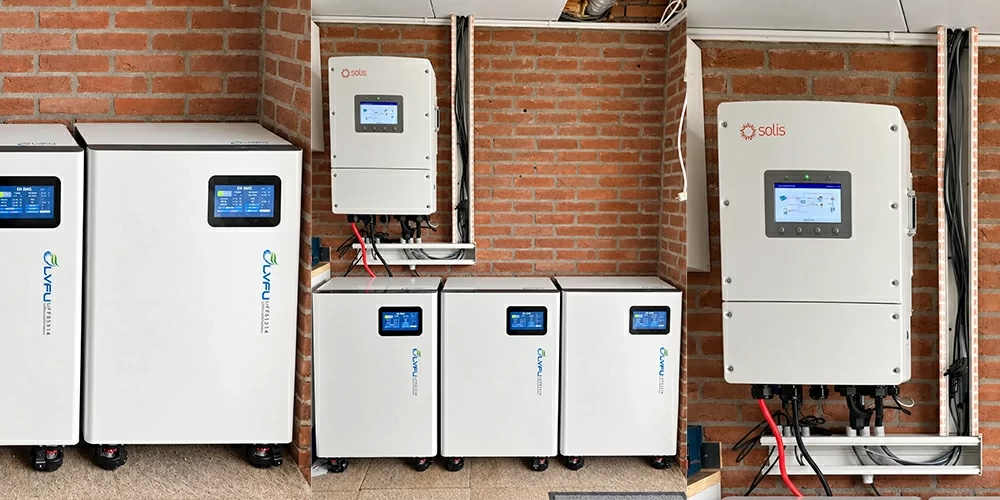
LVFU recently received installation feedback from a residential energy storage customer in the Netherlands. The customer already owned rooftop solar panels and a Solis inverter, and LVFU supplied three 51.2V 314Ah floor-standing LiFePO₄ batteries to complete the home solar-plus-storage system. According to the customer’s feedback, the batteries achieved good compatibility with the Solis inverter, and the whole system now operates in coordination.
| Item | Details |
| Location | Netherlands |
| Battery type | Floor-standing LiFePO₄ battery |
| Specification per unit | 51.2V / 314Ah (approx. 16.08 kWh nominal energy) |
| Number of units | 3 floor-standing batteries in parallel |
| Total nominal capacity | Approx. 48.24 kWh |
| Inverter | Customer-owned Solis inverter |
| System configuration | Customer-owned rooftop solar panels + Solis inverter + LVFU storage batteries |
| Application | Daily household consumption, solar energy storage, and backup power |
The on-site photos show the three LVFU floor-standing batteries neatly lined up against the indoor brick wall, with their LCD displays lit and showing operating data; the Solis inverter mounts on the wall above, and the cables run through organized trunking, which keeps the whole installation clean and orderly.
2. Compatible with Solis Inverters for Coordinated Solar and Storage Operation
In this project, the LVFU floor-standing batteries work alongside the customer’s own Solis inverter. The battery BMS supports CAN / RS485 communication and coordinates charging, discharging, and energy management with the inverter. Final compatibility depends on on-site commissioning results and LVFU’s official protocol list.
In daily operation, the system follows a clear energy priority:
- Daytime: the rooftop solar panels first supply the household loads, and any surplus power charges the LVFU batteries;
- Night / low sunlight: the batteries release the stored energy and continue powering the home, which raises the solar self-consumption rate and reduces grid purchases;
- During an outage: provided the inverter includes a backup output and the corresponding circuit, the system can supply designated critical loads.
By combining solar generation with battery storage, the household manages its energy use more flexibly and optimizes electricity costs against price fluctuations.
3. Three Units in Parallel Deliver Approx. 48kWh for Whole-Home Storage
To begin with the numbers, each 51.2V 314Ah battery stores approximately 16.08 kWh, so the three units in parallel provide approximately 48.24 kWh of nominal capacity and form a large-capacity residential storage system.
As a result, this capacity level brings three practical benefits:
- More overnight coverage: since the Netherlands enjoys long summer daylight but weaker winter sun, a large battery shifts surplus daytime solar generation to nights and overcast days;
- Longer backup duration: during an outage, the batteries can support critical loads such as refrigerators, lighting, and heat pumps for longer periods;
- Room to expand: if household demand grows, the owner can evaluate future expansion together with the inverter specifications and the on-site electrical design.
4. Floor-Standing Design Enables Flexible, Load-Free Installation
Beyond capacity, the floor-standing structure simplifies installation. The LVFU batteries feature an all-in-one cabinet design with casters at the base, so they require no complex wall reinforcement and go into place directly. The three units line up neatly in the indoor corner, complementing the wall-mounted Solis inverter above, and their layout makes operating information and routine maintenance easy to access.
In addition, the batteries use high-safety LiFePO₄ cells and integrate an intelligent Battery Management System (BMS). The BMS monitors voltage, current, temperature, and operating status in real time, and it delivers multi-layer protection against overcharge, over-discharge, over-current, short circuit, and over-temperature.
5. Conclusion
Taken together, this Dutch residential project demonstrates the good compatibility between the LVFU 51.2V 314Ah floor-standing battery and the Solis inverter in home solar storage applications. More importantly, it shows the practical value of large-capacity floor-standing storage for European households: higher solar self-consumption, optimized electricity costs, and reliable backup power.
If you are planning a similar project, and looking for a LiFePO₄ battery solution that works with Solis and other mainstream inverters for residential or commercial applications, contact the LVFU team today for product specifications, protocol lists, and quotations.
Frequently Asked Questions (FAQ)
Q1: Can LVFU batteries work with Solis inverters? Yes. LVFU battery BMS supports CAN / RS485 communication and mainstream inverter protocols; in this project, three LVFU floor-standing batteries run with the customer’s own Solis inverter. Please refer to LVFU’s official protocol list and on-site commissioning results for specific compatibility.
Q2: How much energy do three 51.2V 314Ah batteries store? Each unit stores approximately 16.08 kWh, so three units in parallel provide approximately 48.24 kWh of nominal capacity in total.
Q3: What advantages does a floor-standing battery offer over a wall-mounted one? The floor-standing all-in-one cabinet requires no wall reinforcement, installs flexibly, delivers larger per-unit capacity (approximately 16.08 kWh in this case), and allows easy positioning and daily maintenance.
