

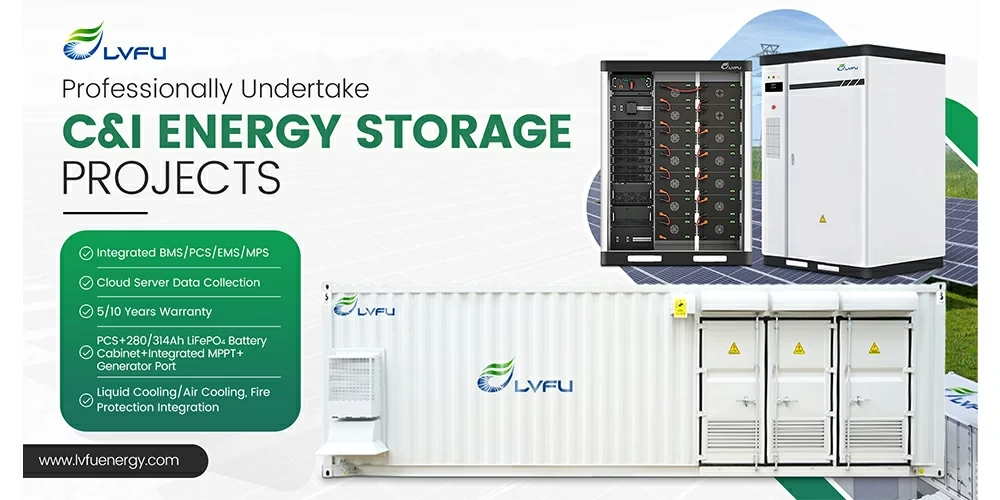
Scope: Commercial and industrial (C&I) energy storage systems, including containerized BESS, cabinet-type storage, and projects of 100kWh and above.
Part 1: Core Cell and Battery Pack Certification – TISI Mandatory Certification
C&I energy storage systems must also pass TISI certification. In fact, the process mirrors residential storage requirements in principle, but involves stricter scrutiny due to the larger number of cells and greater system complexity.
1. Applicable Standards
- Current mandatory standard: TIS 2217‑2548 (old IEC 62133)
- Recommended upgrade: TIS 62133‑2:2565 (aligned with IEC 62133‑2) – switching now ensures full compliance once this becomes mandatory.
2. Key Certification Restrictions
Certificate holder must be a locally registered entity in Thailand. Foreign manufacturers cannot directly hold a TISI certificate.
On-site factory audit is mandatory. For large-capacity systems, auditors pay extra attention to production consistency across batches.
QR code labeling is also mandatory. Each container or cabinet must carry its own independent label.
Part 2: Grid-Connection Certification (PCS and System-Level) – Must Be Listed on the MEA/PEA Whitelist
C&I storage systems typically operate at higher power levels. Therefore, they must meet both MEA and PEA grid-connection requirements. Large-scale projects may also involve EGAT.
1. Inverter/PCS Grid-Connection Standards
Systems must comply with the MEA/PEA Grid Code. In addition, manufacturers must provide IEC test reports from accredited third-party bodies, covering:
- IEC 62109‑1 / -2 – Inverter safety
- IEC 61727 – Grid interface characteristics
- IEC 62116 – Anti-islanding protection
2. System-Level Standards – Specific Requirements for C&I Systems
Beyond inverter-level tests, C&I systems must also provide system-level safety test reports. These should align with either:
- UL 9540 – Energy storage system safety, or
- IEC 62933 series – Electrochemical energy storage system safety
3. Whitelist Application Process
First, submit the above test reports and system technical documentation to MEA or PEA. Then, the authority’s technical committee reviews the submission. Once approved, the product models are listed on the official whitelist. At that point, installers can proceed with grid-connection procedures.
Part 3: Additional C&I-Specific Requirements – Generally Not Applicable to Residential Storage
1. DIW (Department of Industrial Works) Approval
When installing large-capacity BESS within factory premises, you must notify the DIW and update the factory operating license (Ror.Ngor.4).
The review focuses on three main areas:
- Fire safety clearance distances
- Pressure relief design
- Hazardous substance safety assessment for storage cabinets
2. Fire Suppression and Hazardous Materials Compliance – Increasingly Strict
Thailand has steadily tightened fire safety reviews for high-voltage, large-capacity lithium battery installations. C&I energy storage systems must incorporate proven fire suppression systems – such as FK‑5‑1‑12 / Novec 1230 perfluorohexanone fire extinguishing systems.
Furthermore, systems must pass building and electrical fire safety assessments as specified by the Engineering Institute of Thailand (EIT) .
