

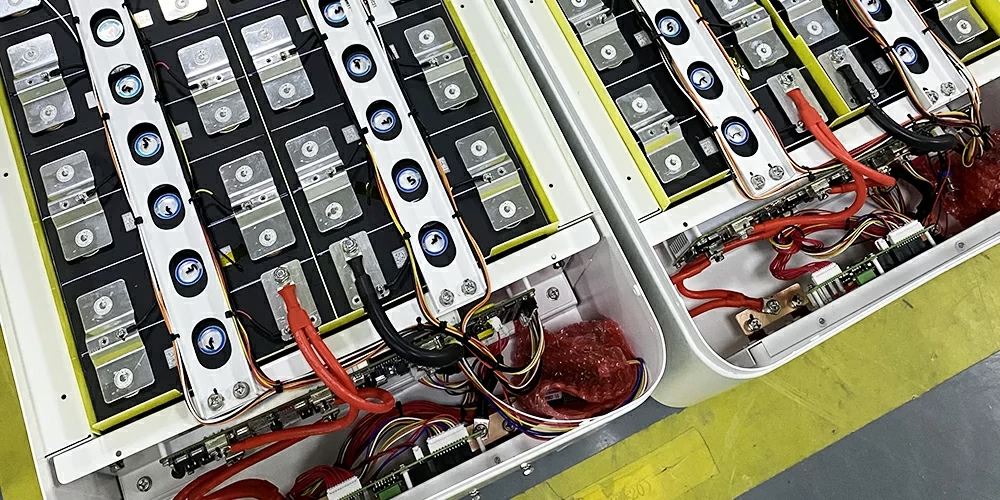
The Battery Management System (BMS) serves as the safety controller for a lithium battery pack. Rather than guaranteeing that a battery will never experience a fault, it manages risk through a clear sequence: real-time measurement, threshold monitoring, charge and discharge control, and current interruption when conditions become severe.
For LiFePO₄ batteries commonly used in energy storage, the BMS monitors each cell’s voltage, the total pack voltage, charge and discharge current, temperature, and state of charge (SOC). Depending on the system design, it may also monitor insulation and contactor status. Together, these measurements allow the BMS to detect abnormal conditions early and respond before they escalate.
Preventing Overcharge
The BMS protects the battery from overcharge by monitoring the voltage of every cell. When a cell reaches the voltage threshold specified by the manufacturer, the system usually responds in stages. First, the voltage rises to the warning level. The BMS then issues a warning or starts balancing the cells. If the voltage continues to increase, it can instruct the inverter to reduce or stop charging. In a severe case, it disconnects the charging circuit.
This process provides Over Voltage Protection (OVP). By acting progressively, the BMS can correct or contain an abnormal charging condition before it damages the battery.
Preventing Over-Discharge
The BMS applies the same principle in reverse during discharge. It continuously checks the voltage of every cell. If one cell falls to the minimum allowable voltage, the system cannot continue discharging indefinitely, even when other cells still retain charge.
The BMS first issues a low-SOC or low-voltage warning. It then asks the inverter to stop discharging and, when necessary, disconnects the discharge circuit. This function, known as Under Voltage Protection (UVP), helps prevent the performance loss associated with prolonged deep discharge. More importantly, it helps avoid the irreversible damage that severe over-discharge can cause.
Preventing Overcurrent and Short Circuits
In addition to voltage, the BMS measures battery current in real time. Consider a 51.2 V, 200 Ah battery with a manufacturer-rated maximum continuous discharge current of 100 A. Under normal conditions, the battery can deliver approximately 5.12 kW:
51.2 V × 100 A ≈ 5.12 kW
If an inverter suddenly demands 150 A, the BMS detects that the current has exceeded the permitted limit. It then triggers Over Current Protection (OCP). Depending on the duration and severity of the event, the system may limit the current, issue an alarm, or stop discharging altogether.
A short circuit requires a faster response because the current can surge almost instantly. In that situation, the BMS can rapidly switch off the MOSFETs or command the contactor to open.
However, the BMS does not provide the only line of defense against short circuits. A complete energy storage system should also include hardware protection such as fuses, circuit breakers, and contactors. System designers should therefore distribute safety responsibility across the full protection architecture rather than relying on the BMS alone.
Managing High and Low Temperatures
The BMS uses temperature sensors installed near battery cells, busbars, or other critical components to monitor thermal conditions. When the temperature remains within the normal range, the battery can charge and discharge normally. If it continues to rise, the BMS issues a warning and reduces charging or discharging power. Once the temperature exceeds the protection threshold, it stops the relevant operation.
This function provides Over-Temperature Protection (OTP). The system must also manage low-temperature conditions, especially when charging LiFePO₄ batteries. In many applications, the BMS limits or disables charging when the temperature falls below a specified threshold because low-temperature charging presents a greater risk than low-temperature discharging.
A BMS protects a lithium battery system by continuously measuring operating conditions and taking progressively stronger action when readings exceed safe limits. It helps prevent overcharge, over-discharge, overcurrent, short-circuit events, and unsafe temperatures. Nevertheless, effective battery safety depends on more than the BMS alone. Engineers must combine the BMS with suitable fuses, circuit breakers, contactors, inverter controls, and thermal safeguards to build a complete energy storage protection system.
