

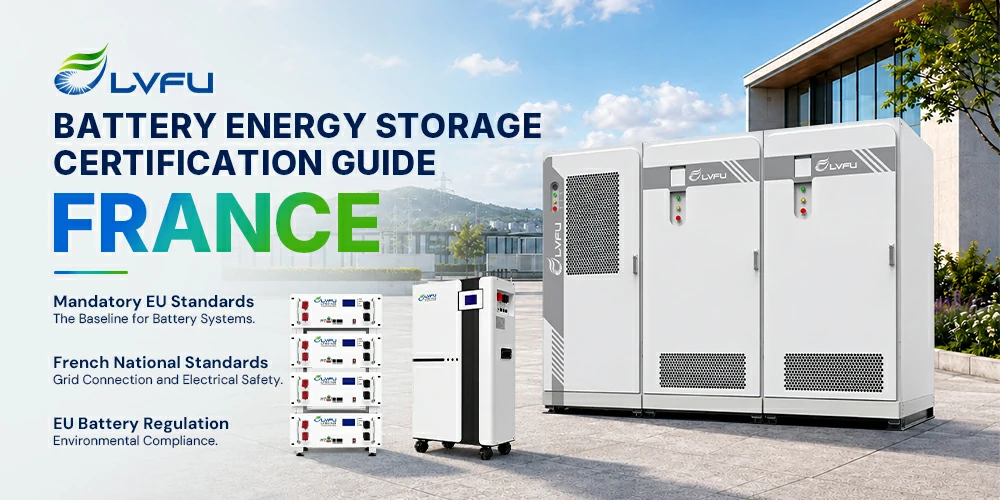
Entering the French energy storage market requires navigating a multi-layered certification framework. Manufacturers must meet three distinct levels of compliance: general EU mandatory standards, French national grid-connection requirements, and environmental regulations. This guide walks you through each requirement step by step, helping you understand what applies to your system and how to prepare.
Part 1: Mandatory EU Standards – The Baseline for Battery Systems
Before you can place any lithium-ion battery energy storage system on the French market, you must obtain CE marking and issue a Declaration of Conformity (DoC). Beyond that, several technical standards apply.
Transport Safety – A Mandatory Prerequisite
Before shipping battery modules or complete systems to France by sea or air, you must complete the following documentation:
- UN 38.3 – Transport safety testing for lithium batteries
- MSDS (Material Safety Data Sheet) – Chemical safety information
- Sea/Air Transport Assessment Report – Hazardous goods classification and packaging verification
Core Battery Safety Standard – IEC 62619
IEC 62619 sets the safety requirements for industrial and energy storage lithium batteries. Specifically, it covers thermal runaway prevention, overcharge and over-discharge protection, and BMS protection logic.
Electromagnetic Compatibility (EMC) Directive – 2014/30/EU
To comply with the EMC Directive, you must test your battery BMS and integrated controllers against the EN IEC 61000 series. This ensures two things: first, the system does not emit harmful radiation; second, it remains immune to external electromagnetic interference. The relevant standards include:
- EN IEC 61000-6-1 / 6-2 – Immunity standards for residential and industrial environments
- EN IEC 61000-6-3 / 6-4 – Emission standards for residential and industrial environments
Low Voltage Directive (LVD) – 2014/35/EU
Under the LVD, you must conduct electrical safety testing for your energy storage system or Power Conversion System (PCS). The relevant standards are:
- EN 62477-1 – Safety of power electronic converter systems
- EN 62109-1 / -2 – Safety of power converters for photovoltaic systems
C&I System Extension – IEC 62933-5-2
For medium and large C&I energy storage systems, you should also comply with IEC 62933-5-2. This standard covers system-level safety, including fire safety, explosion protection, and gas emission design.
Part 2: French National Standards – Grid Connection and Electrical Safety
Here is a crucial point to understand: CE certification alone does not permit you to install or connect a storage system to the French grid. You must also meet the following French national requirements.
Grid Connection Technical Standards
For residential and small-scale C&I systems connected to the low-voltage (LV) grid, the inverter/PCS must comply with EN 50549-1. This standard covers anti-islanding protection, frequency and voltage response, and grid adaptability.
For medium and large-scale C&I systems connected to the medium-voltage (MV) grid, you must comply with EN 50549-2.
In addition, you must meet NF C 15-400 – the French electrical safety standard for photovoltaic grid-connection installations. The French distribution system operator Enedis also publishes specific technical requirements for energy storage interconnection (refer to Enedis-NOI-CPT_54E and related technical documents).
Electrical Installation and Fire Safety Standards
Two key documents govern the installation of energy storage systems in France:
UTE C 15-712-1 – This serves as the authoritative installation guide for PV and energy storage systems. It requires compliant DC isolation, overcurrent protection, and lightning protection measures.
NF C 15-100 – This provides the general electrical installation standard for France. Upon project completion, you must pass an on-site inspection by Consuel (the French National Committee for Electrical Safety) before you can energize the system and connect it to the grid. Consuel inspection applies to all new electrical installations and major modifications.
ICPE Environmental Regulations – For C&I Systems
For large-capacity C&I energy storage systems, you must also comply with the French ICPE (Classified Installations for Environmental Protection) framework. This applies to systems exceeding specific thresholds – typically those with rated power above 100kW or storage capacity exceeding certain limits.
ICPE compliance covers:
- Venting of gases from thermal runaway events
- Fire separation distances
- Emergency response procedures
- Explosion risk assessment and mitigation
NF Mark – A Competitive Advantage
While not mandatory, obtaining the NF mark (French voluntary certification mark) can significantly enhance your market competitiveness. Many French specifiers and project developers prefer or require NF-certified equipment, as it demonstrates compliance with French best practices.
Part 3: EU Battery Regulation – Environmental Compliance
The EU Battery Regulation (Regulation 2023/1542) imposes additional obligations on battery systems placed on the French market. Here is what you need to know.
Digital Battery Passport
From 2027, every industrial and energy storage battery with a capacity exceeding 2 kWh must carry a QR code. This code links to a digital battery passport that contains key data: battery chemistry, manufacturing details, cycle life, and carbon footprint information.
Carbon Footprint Declaration
You must also provide a report calculating the full life-cycle carbon footprint of your battery system, following the methodology set out in the implementing acts of the regulation.
Environmental Protection and Recycling – RoHS/REACH & EPR Registration
Finally, you must meet hazardous substance restrictions under RoHS and REACH. In addition, you – or your local French importer – must register for Extended Producer Responsibility (EPR) under the French WEEE and battery recycling framework. This registration ensures that you fulfill your obligations for the collection, treatment, and recycling of waste batteries.
Summary Checklist
| Requirement Level | Key Standards / Actions |
|---|---|
| EU Mandatory | CE marking, DoC, UN 38.3, MSDS, IEC 62619, EN 61000 series, EN 62477-1 / EN 62109 |
| French National | EN 50549-1/-2, NF C 15-400, Enedis technical requirements, UTE C 15-712-1, NF C 15-100, ICPE compliance (C&I), Consuel inspection |
| Environmental | EU Battery Regulation (passport, carbon footprint), RoHS, REACH, EPR/WEEE registration |
