

Real Installation Feedback from Europe · LVFU Energy Storage Battery Overseas Application
I. Project Overview
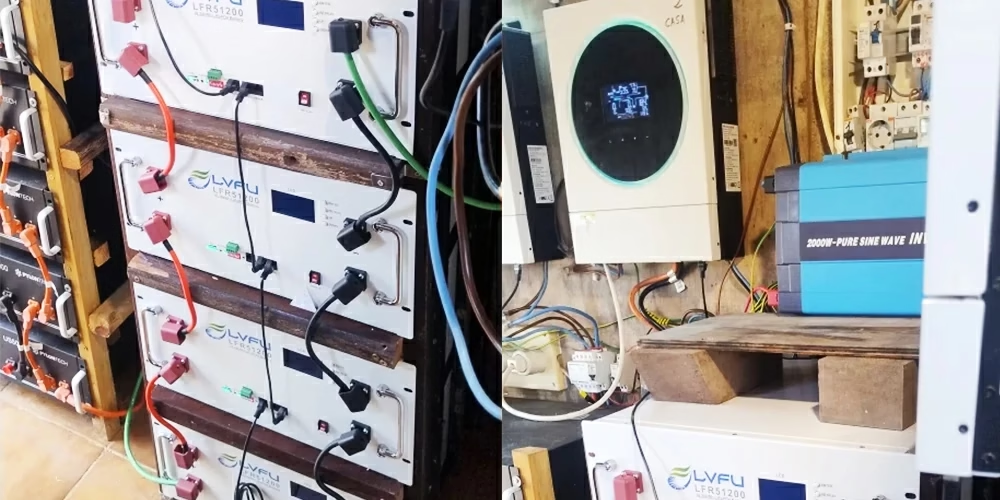
Recently, we received on-site installation photos from a customer on a Spanish island. The local grid is well established and reliable. However, as electricity prices continue to rise, the customer wanted to use a solar-plus-storage system to increase self-consumption, cut electricity bills, and keep backup power for occasional line maintenance or outages — making home energy both more affordable and more secure.
Therefore, this project uses four LVFU LFR51200 rack-mounted lithium iron phosphate (LiFePO₄) batteries in parallel, forming a storage battery bank with a total capacity of approximately 40kWh.
| Item | Parameter |
| Battery Model | LFR51200 |
| Single Unit Spec | 51.2V / 200Ah (approx. 10.24 kWh) |
| Quantity | 4 units in parallel |
| Total System Capacity | Approx. 40 kWh |
| Cell Type | Lithium Iron Phosphate (LiFePO₄) |
| System Type | Grid-tied solar-plus-storage system (with backup function) |
| Communication | CAN / RS485 |
| Compatible Equipment | Hybrid inverter, 2000W pure sine wave inverter |
As the on-site photos show, the four batteries use a floor-standing cabinet installation. The structure is stable, the layout is compact, and the system makes full use of the limited space in the home. Meanwhile, the system is running normally, with smooth charging and discharging.
In addition, the customer has a hybrid inverter and a 2000W pure sine wave inverter on site. The LFR51200 features a built-in intelligent BMS and supports CAN / RS485 communication. As a result, it adapts perfectly to the customer’s existing inverter equipment and completes grid connection without any additional modification.
II. Why Energy Storage Batteries Benefit Grid-Tied Homes
In areas with reliable grid access, home energy storage batteries help users make better use of solar power, reduce dependence on grid electricity during specific periods, and improve energy resilience with compatible backup power configurations.
Specifically, for homes with solar panels, excess daytime generation can be stored in the battery and used later when solar output drops. Depending on electricity prices, system settings, and household usage patterns, this approach helps reduce grid purchases.
Moreover, when the hybrid inverter, backup output, and electrical installation are properly configured, the storage battery can also power some household loads during a grid outage.
III. Conclusion
From mainland Europe to island regions, LVFU energy storage batteries are providing stable and reliable green energy support for diverse power scenarios worldwide. The successful completion of this grid-tied storage project on a Spanish island once again proves the outstanding compatibility and durability of the LFR51200 rack battery in grid-tied solar-plus-storage applications — whether for self-consumption to lower bills or for protecting critical loads during sudden outages, it performs with ease.
If you are also looking for a highly compatible, easily expandable lithium iron phosphate energy storage battery solution for residential, farm, or commercial and industrial scenarios, welcome to contact the LVFU team for product information and quotations.
