

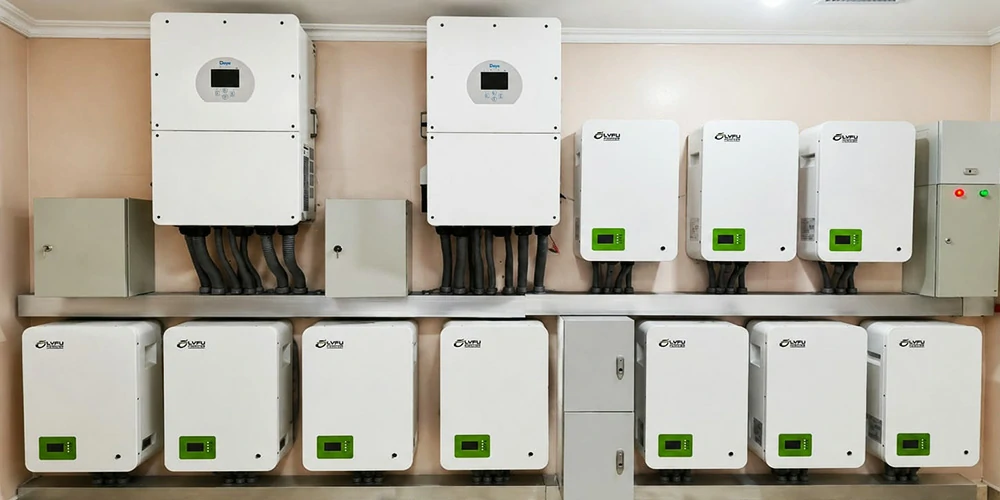
10 x LVFU 10kWh Wall-Mounted Batteries + 2 x Deye Inverters
Project Background
Project Location: Philippines (remote island / rural area / off-grid region)
System Type: Pure off-grid solar + storage system (independent microgrid)
Core Requirement: Provide 24/7 uninterrupted power supply with no grid support, relying entirely on PV + battery storage.
System Specifications
| Parameter | Details |
|---|---|
| Total Storage Capacity | 100kWh (10 units × 10kWh) |
| Usable Capacity | 80kWh (based on 80% DoD) |
| Total Inverter Power | Two Deye inverters in parallel – total output 20kW (depending on model) |
| Off-Grid Output | Single-phase 220V/230V, 60Hz (Philippines standard) |
| Peak Load Capacity | Instantaneous overload up to 2× rated power (approx. 40–48kW) |
Equipment Selection – Off-Grid Specific Configuration
Deye Inverter Requirements
For pure off-grid applications, the Deye inverter must support parallel operation in off-grid mode. Furthermore, you must configure the system with a master/slave setup.
Selected Model: Deye SUN-10K-SG06LP1-EU – single-phase 10kW, supports off-grid parallel connection.
LVFU 10kWh Wall-Mounted Battery
| Parameter | Specification |
|---|---|
| Nominal Voltage | 51.2V |
| Nominal Capacity | 100Ah / 10kWh |
| Battery Chemistry | LiFePO₄ (Lithium Iron Phosphate) |
| Cycle Life | ≥ 6,000 cycles @ 80% DoD |
| Communication Protocol | CAN / RS485 |
| Mounting Type | Wall-mounted |
Installation Key Points
1. Wall Mounting
First, ensure the wall structure meets the requirements. The wall must be made of concrete or solid brick and must support a load capacity of at least 700kg.
Next, arrange the batteries in layers, keeping the bottom of each unit at least 300mm above the floor.
For the inverters, install them side by side with a minimum clearance of 300mm between units.
Finally, connect all equipment enclosures to a common grounding system, ensuring the grounding resistance stays below 4Ω.
2. Inverter Parallel Wiring – Critical Step
For the parallel connection, follow these steps:
First, connect the parallel communication ports using Deye’s dedicated communication cables.
Then, set the master and slave units via the software interface or DIP switches according to the system configuration.
After that, connect the AC outputs – tie the L (live), N (neutral), and PE (protective earth) conductors from both inverters together, and then route them to the main distribution panel.
System Operation Results
After completing the installation and commissioning, the system now delivers the following performance:
- Daily solar generation meets the site’s full daytime load requirements
- Battery capacity of 100kWh provides 3–5 hours of pure battery runtime (at 80% DoD)
- Diesel consumption – eliminated entirely during daylight hours; generator only used as emergency backup
- System automation rate exceeds 95%, requiring minimal manual intervention
Key Benefits Delivered
| Benefit Category | Details |
|---|---|
| Energy Independence | The system operates completely off-grid – no reliance on unstable or unavailable utility power |
| Cost Savings | Significant reduction in diesel fuel costs for power generation |
| Environmental Impact | Reduced CO₂ emissions and cleaner operations for the remote site |
| Reliability | Uninterrupted 24/7 power supply with automatic failover and overload protection |
| Scalability | Modular design allows easy expansion by adding more battery units or inverter modules |
This Philippines off-grid installation demonstrates how combining LVFU’s 10kWh wall-mounted batteries with Deye’s parallel-capable inverters creates a reliable, cost-effective, and scalable energy solution. For remote islands and rural areas without grid access, this system architecture offers a proven path to energy independence – and one that can be replicated across similar sites throughout the region.
