

I. Background information of Project
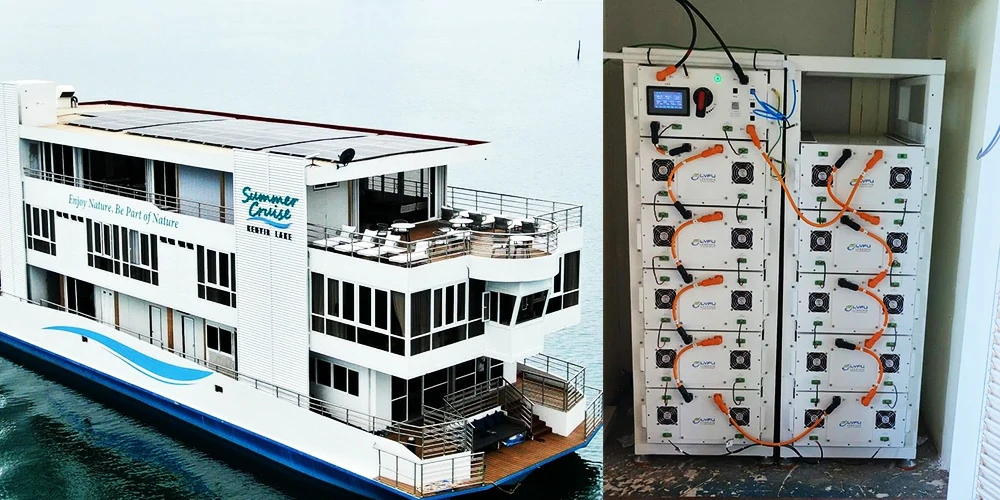
| Project name | Summer Cruise Pertama’s Solar energy + Energy storage battery +Generator Integrated System |
| Application Scenarios | Luxury cruise ship shore power facilities + zero-emission berthing at the port |
| Energy storage specifications | LVFU ESS 16kwh Modular energy storage system, Total 160kwh/80kw |
| Installation site | Malaysia Summer Cruise Kenyir Lake |
| Project cycle | 2 weeks production,1week commissioning |
1.1 Industry Background:
Summer Cruise Pertama is a sightseeing cruise ship operating in Malaysian waters, with routes covering popular island destinations such as Langkawi, Redang Island, and Perhentian Island. The shipowner aims to create an environmentally friendly cruise ship, reducing diesel consumption and lowering operating costs through solar power generation, while also responding to the Malaysian government’s sustainable tourism development policies.
1.2 Failure of Initial cooperation
The shipowner initially chose to partner with a solar company specializing in grid-connected systems. This company had extensive experience in rooftop photovoltaics and grid-connected power generation, but its capabilities proved severely lacking when faced with the off-grid scenario for cruise ships.
Result: The system was in a state of “generating electricity but unable to provide stable power” for a long time, and the crew had to frequently switch generators manually, rendering the solar system useless.
II. Turning Point: The Decisive Decision of “Losing Less is Winning”
Faced with months of system instability, shipowners realized a key problem:
“Many solar companies can sell and install, but when it comes to off-grid systems, they may not have sufficient design, integration and debugging capabilities.”
After in-depth evaluation, the shipowner made a difficult but wise decision – “lose less and win more”:
Persuade the original partner to voluntarily withdraw, and introduce a professional team LVFU: who is the integrator with extensive practical experience in off-grid systems.
III. System Operation Results
| INDEX | DATA |
| Daily average solar power generation | Around 100-160 kWh(Depending on the weather) |
| LVFU battery capacity | 160 kWh(It can be powered by pure battery for 3 to 5 hours) |
| Diesel Daily consumption | It has decreased by approximately 60-70% compared to before the renovation |
| System automation rate | >95%(Very little human intervention is required) |
IV. Core Benefits
| Benefits | Specific |
| Economic benefit | Annual savings on diesel costs are approximately RM110,000-130,000 . |
| Environmental protection benefits | Annual CO₂ emissions reduced by approximately 20-30 tons |
| Experience income | Zero noise and zero vibration during the flight significantly improves passenger comfort. |
| Operation and maintenance revenue | Reduced generator wear and extended overhaul cycle |
| Brand value | “Green Cruise Ship” Positioning Enhances Market Competitiveness |
Advice from the Cruise owner:
If you’re planning to install an off-grid or hybrid solar system but lack the necessary knowledge, choosing a truly professional supplier with extensive practical experience is paramount. Otherwise, you’ll not only waste time but may also suffer unnecessary losses.
Green energy is not just about saving costs; it’s our commitment to environmental protection and sustainable development.
