

As we step into 2026, the global energy storage market finally leaves behind the early phase of “mandatory storage pairing.” Instead, we enter a new era of value growth—one driven by economic efficiency and system performance. In this technical race, the evolution of cell capacity takes center stage. The shift from the former industry standard 280Ah to today’s widely adopted 314Ah isn’t just a number change. It reflects a real leap in energy efficiency, cost control, and manufacturing quality.
I. 280Ah: The “Grandmaster” Steps Down
Between 2023 and 2024, the 280Ah cell ruled the large-scale energy storage market. It set the classic physical dimensions for storage cells and pushed forward the standardization of 3.72MWh systems inside a 20-foot container.
However, as the market started chasing the ultimate Levelized Cost of Electricity (LCOE) , the weaknesses of the 280Ah cell became clear. Because each cell holds less energy, building a large power station required more cells, more BMS channels, and more structural parts. That, in turn, increased system integration difficulty and long-term maintenance costs.
II. 314Ah: The “Golden Standard” of 2026
By 2026, the 314Ah cell has completely replaced 280Ah as the baseline choice for mainstream energy storage projects worldwide. Why did this spec take over so quickly? Because it strikes a great balance between “high compatibility” and “high efficiency.”
1. Same Size, Easy Upgrade
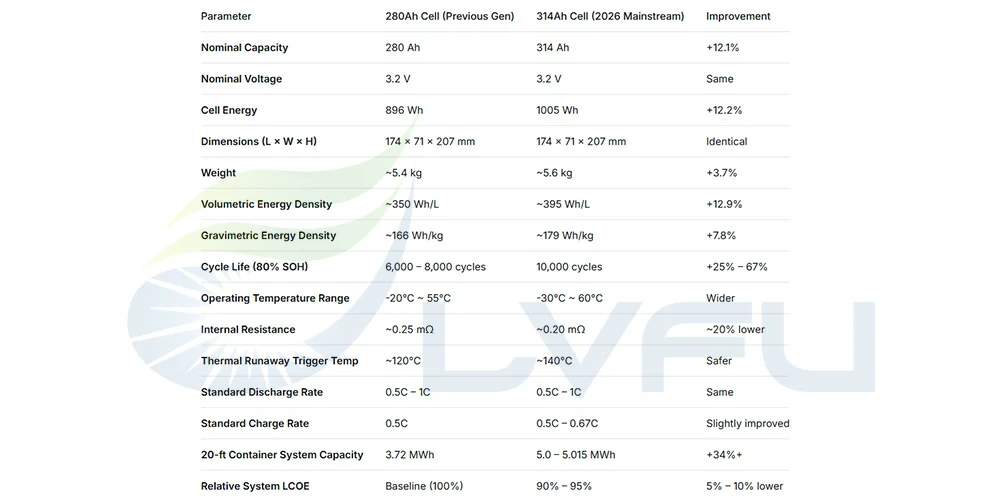
The smartest part of the 314Ah design? It keeps the exact same physical dimensions as the 280Ah. That means system integrators can upgrade their products quickly without overhauling production lines or redesigning Pack modules. We call this a “drop-in” upgrade.
2. Hello, 5MWh Era
Thanks to the 314Ah cell, a standard 20-foot storage container now jumps from 3.72MWh to 5MWh. This leap in energy density cuts the footprint of a same-scale power station by about 30%. That’s a huge gain in real estate efficiency.
3. Better All Around
Compared to the previous generation, 314Ah cells deliver over 10% higher energy density. Through technical improvements, their cycle life now stabilizes around 10,000 cycles. More importantly, fewer cells at the system level help lower the overall LCOE by about 5–10%, which significantly shortens the payback period for storage projects.
III. The Technology Behind the Leap
So, how did we get from 280Ah to 314Ah? It wasn’t just “filling in more volume.” It took a combination of several advanced technologies:
- Better Materials
Manufacturers started using cathode materials with higher specific capacity and advanced electrolyte formulas. These improvements help manage the extra heat and expansion that come with larger capacity.
- Safety by Design
As single-cell energy increases, the risk of thermal runaway also grows. By 2026, 314Ah cells come standard with directional pressure relief, early warning systems, and stronger structural integrity. That keeps safety under control.
- Long-Life Tech
To meet the market’s demand for a “20-year lifespan,” these cells now commonly use lithium pre-doping and artificial SEI film repair processes. These technologies significantly slow down electrochemical decay.
IV. Beyond 2026: The Dawn of 500Ah+
Even though the 314Ah cell is now in its “prime,” the big players are already looking ahead. In 2026, ultra-large cells of 500Ah or even 600Ah+ —from giants like CATL and EVE Energy—have begun pilot commercial use in GWh-level power stations.
If 314Ah is an “evolutionary leap” from 280Ah, then these ultra-large cells will likely bring a “disruptive overhaul” of energy storage system architecture.
Conclusion
The leap from 280Ah to 314Ah tells us a bigger story: the energy storage industry is shifting from “chasing scale” to “chasing quality.” This step marks the beginning of a new normal for lithium battery storage—one defined by high energy density, low cost, and high safety. As technology keeps evolving, power dispatch in 2026 will become more flexible, and green electricity will become more affordable and accessible, thanks to these highly efficient “energy vaults.”
