

The Power Conversion System (PCS) serves as the critical link between batteries and the grid. It actively converts DC power from batteries into AC power for grid injection, and reverses the process to convert grid AC into DC for battery charging. By 2026, PCS technology is rapidly advancing toward three key directions: high power density, high conversion efficiency, and strong grid-forming capability.
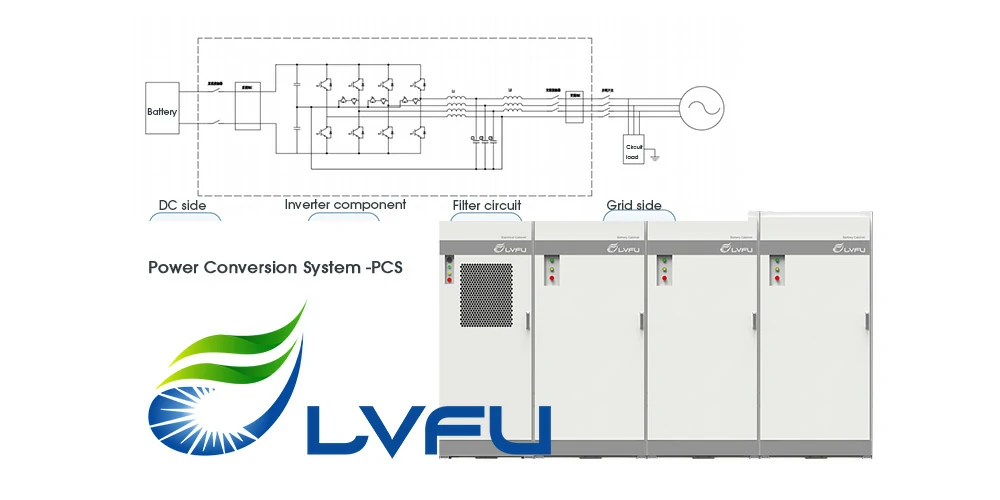
Efficient Bidirectional Power Conversion
First, PCS leverages silicon carbide (SiC) devices and a three-level topology to achieve a conversion efficiency of over 97.5%. For instance, Sungrow’s PowerTitan 3.0 system maintains high efficiency even at 40°C ambient temperature, while delivering an overload capacity of >150% for 10 seconds. These features allow the system to simultaneously optimize demand charges and maximize peak-valley arbitrage.
Grid Support and Grid-Forming Capability
Second, PCS actively provides inertia support to the grid through its virtual synchronous machine (VSG) functionality. Specifically, it doubles short-circuit support capacity and cuts inertia response time to 0.15 seconds. In a 100MW shared energy storage project in Ningxia, Kehua Data deployed VSG technology to achieve fast frequency and voltage regulation, successfully reducing voltage recovery time to under 50 milliseconds.
Multi-Parallel Operation and Black Start
In addition, PCS supports N+1 redundant design, with a single cabinet capacity of 3MWh. Tesla’s Megapack system leverages multi-parallel operation to deliver millisecond-level power response, reliably meeting the power supply demands of critical loads such as data centers. Notably, by 2026, grid-forming PCS has become a mandatory technical requirement in bidding documents across 12 provinces in China.
