

I. Core Market Drivers
Our analysis of Europe’s C&I energy storage market shows that the rapid expansion of commercial and industrial storage results from multiple factors rather than a single cause. Economic viability, regulatory compliance, revenue potential, and energy security together drive this growth
- Economic Optimization (Peak Shaving & Energy Arbitrage): Volatile energy prices and high capacity charges serve as the main motivators. In markets like Germany and Poland, businesses use storage systems to shave peak demand and reduce capacity fees. At the same time, they charge batteries at low prices and discharge during high-price periods, directly lowering energy costs.
- Grid Constraints & Compliance (Self-Consumption & Zero-Feed-In): As renewable energy penetration rises, grid congestion and strict export limits become more common. Hungary’s “zero feed-in” rule forces new PV projects to include storage to prevent reverse power flow. In the Netherlands, storage offers a key solution for easing grid congestion and solving PV connection challenges.
- Grid Service Revenues (Ancillary Services Market): Storage’s fast response capability makes it a critical asset for grid frequency stability. Capacity markets in Romania and Poland, along with Lithuania’s frequency control needs for synchronous operation, provide stable additional revenue streams beyond time-of-use arbitrage.
- Resilience & Backup Power (Microgrids): Geopolitical instability and the urgent need for energy security make uninterrupted power supply a necessity. In Ukraine especially, industrial parks use microgrids and storage systems with off-grid switching capability to maintain business continuity during grid outages.
- Policy & Access Incentives (Subsidies & Easier Interconnection): Government policies directly lower investment barriers. Poland’s “cable pooling” allows storage to share connection points and bypass queue waiting. Capital subsidies in Hungary, legal certainty in Czechia, and tax breaks in Romania all significantly accelerate project deployment.
II. System Configuration & Technology Evolution
2.1 Mainstream Hardware Configuration
The market has established highly integrated modular outdoor cabinets (all-in-one cabinets) as the dominant form factor. These mainly address space constraints, noise sensitivity, and fast deployment needs on commercial sites.
PCS Power Ratings:
- 100 kW – 125 kW (Core Mainstream): Mid-to-large C&I users adopt this dominant standard. The industry shifts from 100 kW to 125 kW to match 1000V–1500V high-voltage battery strings and maximize power density.
- 50 kW – 60 kW (Distributed/SME): A flexible configuration for small commercial applications (e.g., agriculture, SMEs). Representative products include Solis EverCore 50kW and Kstar BluePulse 50kW.
ESS Capacity Grades:
- 215 kWh (Mature Benchmark): The market “workhorse” configuration, typically using 280Ah LFP cells. Major brands like Huawei (LUNA2000) and FoxESS (G-MAX) adopt this grade widely.
- 233 kWh – 261 kWh (High-Density Advanced): Next-generation high-density configurations for 2025–2026. Manufacturers adopt 314Ah+ large-capacity cells to boost capacity within the same footprint (e.g., LVFU Energy reaches 261 kWh), achieving higher energy density.
2.2 Future Technology Roadmap (2026–2030)
- Liquid Cooling Takes Full Lead: To solve thermal management challenges for 314Ah high-density cells, the industry decisively moves from air cooling to liquid cooling (representative brands: Huawei, Sungrow, LVFU). This approach is expected to extend battery cycle life by approximately 20%.
- Sodium-Ion Batteries Enter the Scene: Early commercialization and pilot projects emerge in 2025/2026. Deye and Kstar have already prepared compatible platforms. Although LFP remains dominant due to cost advantages, sodium-ion batteries begin piloting in Northern/Eastern Europe thanks to their low-temperature performance.
- Grid-Forming Capability: For weak grid regions (e.g., the Baltics, Ukraine), next-generation systems must provide “virtual inertia” to support grid frequency.
III. LVFU Energy’s Response to European Market Trends
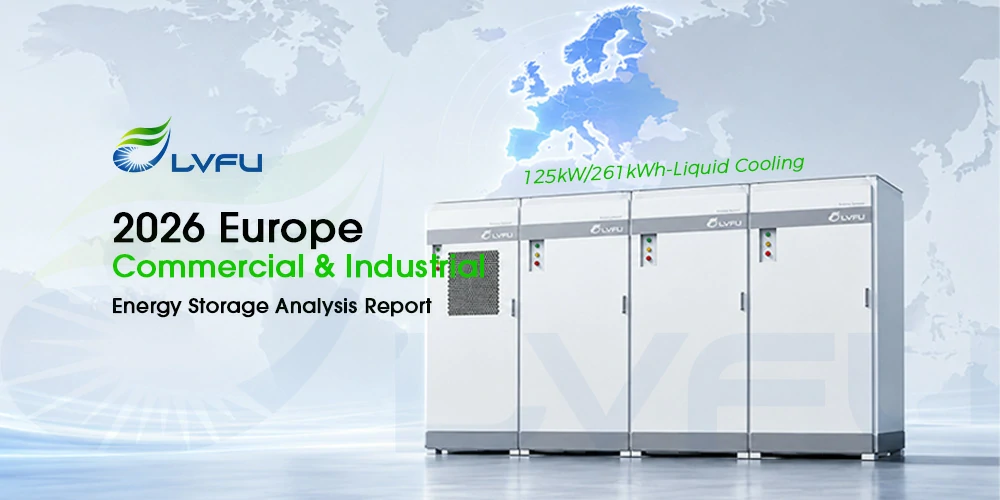
To align with European market trends, LVFU Energy now launches a 125kW / 261kWh C&I energy storage system. This system adopts next-generation 314Ah large-capacity cells and liquid cooling thermal management technology.
It achieves higher energy density and longer cycle life (approximately 20% improvement) within the same footprint. At the same time, the system offers grid-forming capability and millisecond-level off-grid switching functionality. It suits multiple applications, including peak shaving, PV self-consumption, backup power, and ancillary services.
The solution effectively meets diverse market needs in Germany, Poland, Hungary, Romania, the Baltics, and beyond. Through modular design and localized compliance support, LVFU Energy provides European C&I users with a high-economy, high-reliability, and grid-friendly energy storage solution.
IV. Core Application Scenarios
- Peak Shaving: C&I users profit by reducing peak demand capacity charges. This serves as a primary driver in Germany and Poland, requiring systems to support 1C or 0.5C rates.
- PV Self-Consumption: Users respond to high electricity prices and “zero export” restrictions (e.g., Hungary). They typically adopt DC-coupled architectures to improve efficiency.
- Ancillary Services (FCR/aFRR): Systems participate in TSO frequency response markets. Capacity markets in Romania and Poland offer significant revenues, requiring sub-200ms ultra-fast response.
- Resilience & Backup Power: Core demand in Ukraine and weak grid areas requires sub-10ms off-grid switching capability to ensure business continuity.
- Grid Congestion Management & Virtual Power Plants (VPP): In the Netherlands and Benelux region, users aggregate distributed storage resources to relieve pressure on distribution grids.
