

2026 Europe C&I Energy Storage Regulations: Country Market Access Guide
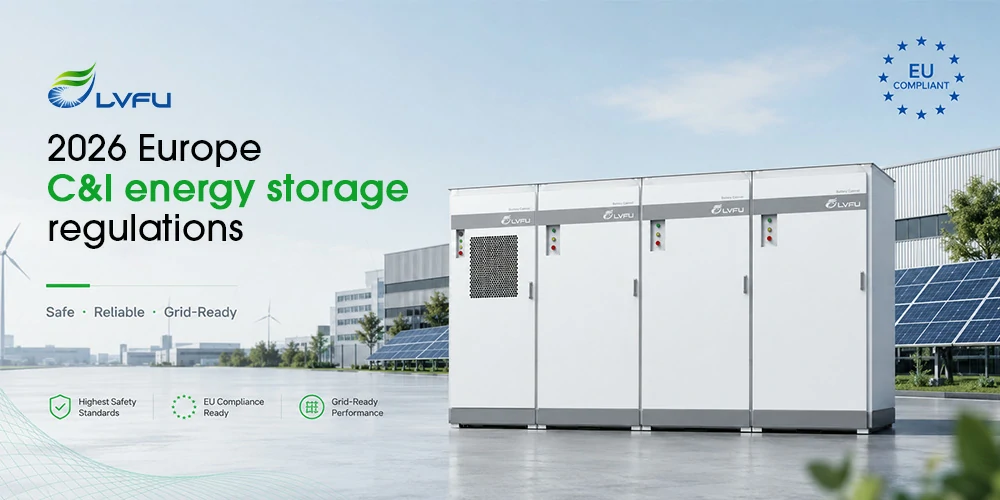
In 2026, Europe’s commercial and industrial (C&I) energy storage market continues to expand amid accelerating energy transition, volatile electricity prices, and growing grid capacity constraints. Germany, Poland, Spain, the Netherlands, and Hungary stand out as the most dynamic markets, each driven by distinct factors such as policy incentives, economic arbitrage, or grid congestion management. Access requirements for energy storage systems are becoming increasingly stringent, covering grid connection codes, equipment certification, and flexibility market rules. This article provides a concise analysis of market characteristics and access essentials in these key countries, serving as a reference for companies looking to enter the European C&I storage market.
Germany
Features: The most mature market, with over 400 MWh of project pipeline, driven by high arbitrage potential and grid fee exemptions.
Access Requirements: Strictly complies with “VDE-AR-N 4110” (medium voltage) and “VDE-AR-N 4105” (low voltage) standards. Mandatory certification for power generation equipment (EZE) and power plants (EZA).
Poland
Features: The fastest-growing market. Double boom in SMEs and utility-scale projects, utilizing “cable pooling” to resolve grid connection queues.
Access Requirements: Complies with “IRiESD” (Distribution Grid Code) and NC RfG requirements; a draft law from October 2025 proposes the implementation of a red/yellow/green grid zoning system.
Spain
Features: A hotspot for industrial self-consumption. Sungrow and Kstar have deployed numerous industrial manufacturing projects (e.g., meat processing plants) here.
Access Requirements: Must meet local DSO technical requirements and testing (e.g., AIT tests validating the Southern European market).
Netherlands
Features: Focuses on grid congestion management and Virtual Power Plants (VPPs), with a preference for 50-100kW distributed units.
Access Requirements: Must comply with RfG and local DSO flexibility market rules.
Hungary
Features: Most policy-driven market. Strict ” Zero Feed-In” mandates energy storage with PV. 2025 sees HUF 50 billion in subsidies.
Access Requirements: Elosztói Szabályzat (Distribution Code) and MAVIR operational standards.
Ukraine
Features: Driven by wartime necessity. Industrial park microgrids (SDS) and backup power are essential for survival.
Access Requirements: Requires a €10/kW upfront payment for transmission grid connection; islanding capability is mandatory.
Romania
Features: Standardized development. Focuses on balancing services, with double charging for energy storage already exempted.
Access Requirements: ANRE Order 20/2025 mandates a 5% financial guarantee to filter out speculative projects.
Czech Republic
Features: Legal clarity. The LEX OZE III Act officially recognizes “electricity accumulation” as an independent commercial activity.
Access Requirements: PPDS Annex 4 (P4) is the mandatory technical standard for inverter grid connection.
Lithuania
Features: Driven by geo-security concerns. Focuses on synchronous operation after decoupling from the Russian grid (BRELL).
Access Requirements: Litgrid requires systems to provide synthetic inertia and frequency control (200ms response).
