

The UAE’s Energy Pivot: From Oil Giant to Green Powerhouse
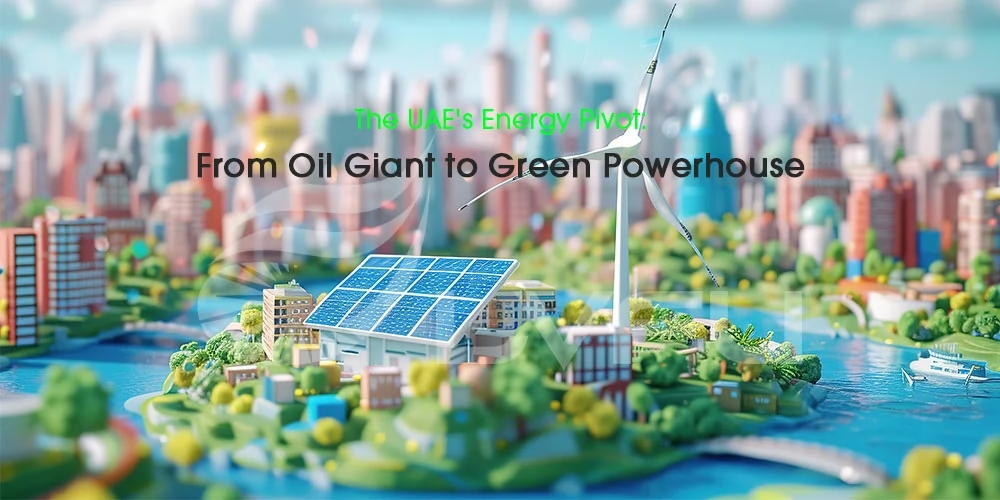
The United Arab Emirates is fundamentally reshaping its energy future—but how? Well, it starts with a decisive turn from a fossil fuel-reliant economy toward one powered by clean energy. Through its landmark National Energy Strategy 2050, the country has set a clear goal: to source half its energy from clean technologies by mid-century. Of course, that kind of shift doesn’t happen by itself. So, to back this vision, the UAE is not only pouring billions into the transition, but also rewriting its market rules—phasing out subsidies and turning instead to tools like carbon trading.
A $160 Billion Blueprint for a New Energy Mix
Now, let’s look closer at the plan itself. The 2050 strategy actually outlines a dramatic overhaul of the country’s energy mix. By 2050, the aim is to draw 44% of power from renewables, 38% from natural gas, 12% from clean coal, and 6% from nuclear. And these changes aren’t just about switching sources—they’re designed to boost energy efficiency by 40% and slash carbon emissions by 70%. Pulling this off obviously requires serious money. That’s why the government has committed $160 billion to energy projects, with a strong focus on renewables. In other words, this isn’t just talk; it’s a financially grounded push to secure the country’s energy and environmental future.
Trading Subsidies for Market Rules
Interestingly, the most transformative part of this strategy may be its market reforms. For years, subsidized fossil fuels were the norm—but that model is now being phased out entirely, with all energy subsidies set to end by 2050. Why? Because letting real market prices drive competition encourages efficiency and innovation. In the meantime, to speed up the green transition, the government is offering special permits, loans, and incentives for renewable projects. In fact, major players like Abu Dhabi’s AD Power and Dubai’s DEWA are already building vast solar farms across the desert.
But that’s not all. On top of that, the UAE is also launching a pilot Emissions Trading Scheme (ETS). This system will require high-polluting industries to buy carbon allowances—essentially putting a price on pollution and giving companies a direct financial reason to clean up. Importantly, this move aligns closely with the UAE’s role as host of COP28 and its commitments under the Paris Agreement. So, it’s clear the country isn’t just making climate pledges; it’s backing them with real policy.
From Plans to Power: Solar, Grids, and Going Local
Beyond policies and market tools, you can already see the change on the ground. Take solar power, for example—it’s surging ahead, with Dubai aiming for 5% clean energy by 2030 under its own Clean Energy Strategy. Meanwhile, on a regional level, the UAE is linking up with neighbors through the Gulf Interconnected Grid, boosting collective energy security. And locally, rooftop solar initiatives are catching on, allowing homes and businesses to generate their own power and rely less on imports.
What’s telling, though, is this: as the UAE’s Energy Minister has pointed out, oil price swings no longer dictate the country’s clean energy plans. In fact, many renewable projects now run without subsidies, proving they can compete on their own. All in all, then, the UAE is steadily steering away from an era of oil dominance toward a future built on market savvy, green tech, and cleaner energy—one step, one solar panel, and one policy at a time.
