

The “firewall” of residential energy storage lithium batteries is short-circuit protection, which the BMS battery management system actively executes automatically.
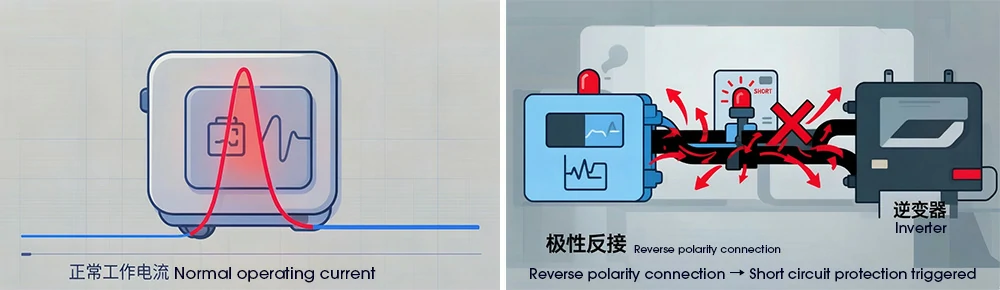
Short circuit protection: the battery’s “self-protection mechanism”
The BMS inside the battery handles this entire process automatically—you do not need to perform any manual steps.
Working principle
BMS will monitor the current in real time. When a short circuit occurs, the current will instantly surge to a maximum value. At this time, the BMS will immediately (usually within tens of milliseconds) cut off the circuit, stop discharging, and protect the safety of the battery and your family.
How to recover
After the short circuit protection is triggered, the battery will “lock” the output. You’ll need to first eliminate the fault causing the short circuit (such as removing a damaged appliance or repairing the wiring). Afterwards, some systems will automatically restore power, while others require you to manually press the reset button on the battery, or disconnect the load and restart the system.
Multi-level protection
In addition to short-circuit protection, BMS also integrates overcharge, over-discharge, over-current and temperature protection to form a complete safety network.
