

1. Project Overview
LVFU recently received operating feedback from a residential solar storage customer in Malaysia. The customer had already installed solar panels on the roof, and LVFU supplied a Deye hybrid inverter together with three 51.2V 100Ah wall-mounted LiFePO₄ batteries.
| Item | Details |
| Location | Malaysia |
| Battery type | Wall-mounted LiFePO₄ battery |
| Specification per unit | 51.2V / 100Ah (approx. 5.12 kWh nominal energy) |
| Number of units | 3 wall-mounted batteries in parallel |
| Total nominal capacity | Approx. 15.36 kWh |
| Inverter | Deye hybrid inverter |
| System configuration | Customer-owned solar panels + Deye inverter + LVFU storage batteries |
| Operating record | Approx. 2 years of continuous operation in good condition (according to customer feedback) |
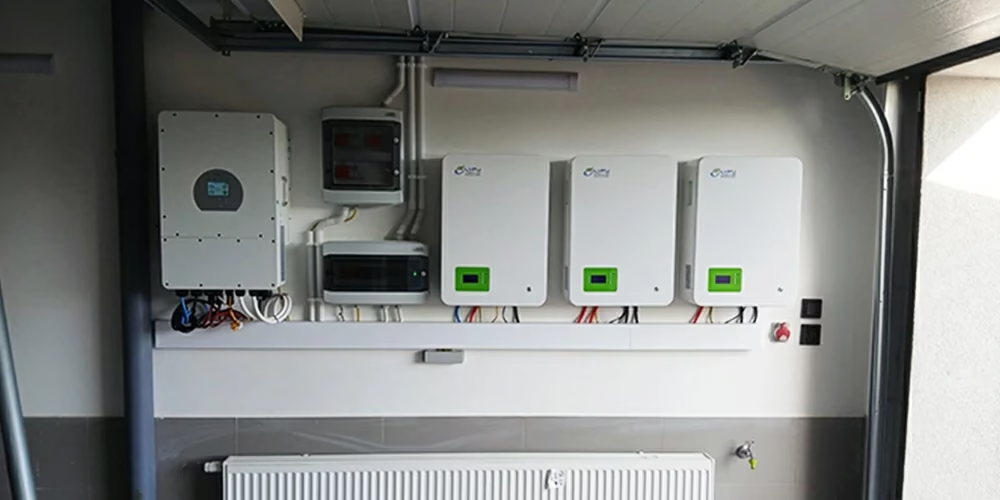
The on-site photos show the three LVFU wall-mounted batteries, the Deye inverter, and the distribution equipment neatly arranged on the same wall, with a compact layout and well-organized cabling. According to the customer’s feedback, the complete system has run continuously for about two years and remains in good condition.
2. Two Years of Continuous Operation Verify Long-Term Reliability
For home energy storage, time proves more than specifications do. Since commissioning, this system has operated continuously for about two years: the batteries and the inverter have worked together through Malaysia’s hot, humid tropical climate, and they have maintained good condition throughout.
As a result, this long operating record gives installers and homeowners a real-world reference for the stability and durability of LVFU wall-mounted batteries in Southeast Asian residential storage applications.
3. Deye Inverter Compatibility Enables Coordinated Solar and Storage Operation
The system adopts a typical low-voltage hybrid storage architecture: the solar panels feed the Deye inverter, the three LVFU wall-mounted batteries connect to the DC side, and the household loads connect to the inverter’s AC output. The batteries and the inverter coordinate charging, discharging, and energy management over CAN / RS485 communication. Final compatibility depends on on-site commissioning results and LVFU’s official protocol list.
In daily operation, the system follows a clear energy priority:
- Daytime: solar power first supplies the household loads, and any surplus charges the LVFU batteries;
- Night / low sunlight: the batteries discharge to keep powering the home, which raises the solar self-consumption rate;
- During a grid outage: provided the inverter includes a backup output and the corresponding circuit, the system can supply designated critical loads. Since some areas of Malaysia experience occasional outages, this backup capability brings practical value to households.
In terms of capacity, the three units deliver approximately 15.36 kWh of nominal storage, which covers daily household consumption, solar energy storage, and backup power needs.
4. Wall-Mounted Design Saves Space and Keeps the Installation Tidy
Beyond capacity, the physical layout also matters in a residential installation. The three batteries mount on the wall, so they use vertical space and occupy no floor area. They sit on the same wall as the Deye inverter and the distribution box, which keeps the installation clean and orderly and lets the user check operating information and carry out routine maintenance with ease.
In addition, the batteries use high-safety LiFePO₄ cells and integrate an intelligent Battery Management System (BMS). The BMS monitors voltage, current, temperature, and operating status in real time, and it delivers multi-layer protection against overcharge, over-discharge, over-current, short circuit, and over-temperature.
5. Conclusion
Taken together, two years of continuous, stable operation offer stronger product proof than any specification sheet. More importantly, this Malaysian residential project demonstrates the compatibility and reliability of the LVFU 51.2V 100Ah wall-mounted battery in Southeast Asian home solar storage applications.
If you are planning a similar project, and looking for a LiFePO₄ battery solution that works with Deye and other mainstream inverters for residential or commercial applications, contact the LVFU team today for product specifications, protocol lists, and quotations.
Frequently Asked Questions (FAQ)
Q1: Can LVFU batteries work with Deye inverters?
Yes. In this project, three LVFU wall-mounted batteries have run with a Deye hybrid inverter for about two years. LVFU battery BMS supports CAN / RS485 communication and mainstream inverter protocols; please refer to LVFU’s official protocol list for specific compatibility.
Q2: How much energy do three 51.2V 100Ah batteries store?
Each unit stores approximately 5.12 kWh, so three units provide approximately 15.36 kWh of nominal capacity in total.
Q3: What advantages does a wall-mounted battery offer?
It uses vertical wall space, occupies no floor area, keeps the installation tidy, and makes operating information and routine maintenance easy to access.
