

Key Takeaways
- CAN bus uses a multi-master protocol: every node can speak, and message IDs resolve priority automatically through non-destructive arbitration.
- RS485 defines a physical-layer standard: one master polls addressed slaves, and an upper-layer protocol such as Modbus RTU organizes the data.
- Choose CAN when you need real-time performance, high reliability, and integration with a vehicle or machine controller.
- Choose RS485 when the system is small, cost-sensitive, and only needs monitoring and data acquisition.
- A correct physical layer does not guarantee communication — you must also match baud rates, node addresses or IDs, and the application-layer protocol.
Introduction
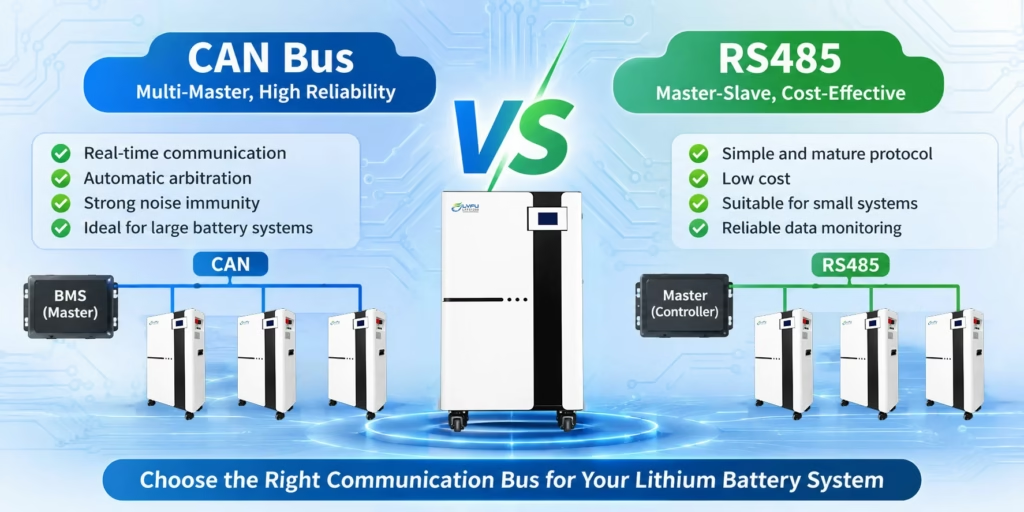
In a lithium battery management system (BMS), battery packs exchange data with each other — and with a host computer or vehicle controller — over a communication bus. Today, the industry relies on two buses more than any others: CAN bus and RS485. As a result, many engineers face the same question during component selection: which one should I use? To help you decide, this article compares the two from four angles: working principles, application differences, wiring, and protocol matching requirements.
1. Working Principles
CAN Bus: Multi-Master Arbitration, Driven by Message IDs
CAN (Controller Area Network) is a multi-master communication protocol. All nodes on the bus are equal, and any node can transmit actively whenever the bus is idle.
Its core mechanism is non-destructive arbitration. When several nodes transmit at the same time, each node listens while sending and compares the bit levels of the message ID to determine priority. The smaller the ID value, the higher the priority. Lower-priority nodes withdraw automatically, while the higher-priority node continues transmitting without interruption — so no data is corrupted.
- Signaling: differential pair (CAN_H / CAN_L)
- Baud rate: commonly 125 kbps to 1 Mbps
- Maximum node count: 110 in theory
- Fault tolerance: built-in CRC checking, error frames, automatic retransmission
RS485: Master-Slave Polling, Driven by Node Addresses
RS485 is strictly a physical-layer standard — it defines electrical characteristics only. It specifies how devices transmit 0s and 1s using differential signaling, but an upper-layer protocol such as Modbus RTU must define how the data is organized.
The typical operating mode is one master with multiple slaves: the master polls, and the slaves respond. The master “calls the roll” by address, and only the addressed slave replies. Slaves cannot talk to each other directly.
- Signaling: differential pair (A / B two wires)
- Baud rate: commonly 9600 bps to 115200 bps (theoretical maximum 10 Mbps, but distance-limited)
- Maximum node count: 32 standard loads (extendable to 256 with repeaters)
- Fault tolerance: no checking at the physical layer; it relies on CRC checking in upper-layer protocols such as Modbus
In one sentence: CAN lets every node compete to speak, with priorities resolved automatically, while RS485 works by master polling and slave responses.
2. Application Differences: Which One for Lithium Batteries?
The table below summarizes the key differences.
| Dimension | CAN Bus | RS485 |
| Typical applications | EVs, energy-storage plants, electric vessels, AGVs | Low-speed storage, backup power, telecom base stations |
| Real-time performance | High (millisecond level or better) | Low (polling cycle depends on slave count) |
| Reliability / noise immunity | Strong (arbitration + automatic retransmission) | Average (relies on upper-layer protocol) |
| Network scale | Easy large-scale networking | Speed drops noticeably with many nodes |
| Cost | Slightly higher chip and development cost | Low cost, mature solutions |
| Ecosystem | Automotive standards (e.g., SAE J1939) | Industrial standards (e.g., Modbus) |
Rule of thumb: If your battery system has many packs, must integrate with a vehicle or machine controller, and demands high real-time performance and reliability — as power batteries and large-scale storage do — choose CAN. On the other hand, if the system is small, budget-sensitive, and only needs data monitoring — such as telecom base-station backup power or small residential storage — RS485 is entirely adequate.
3. Wiring Differences
CAN Wiring
Host CAN_H ──┬── Pack 1 CAN_H ──┬── Pack 2 CAN_H ── …
Host CAN_L ──┴── Pack 1 CAN_L ──┴── Pack 2 CAN_L ── …
Host GND ──── Common ground (strongly recommended)
- Use a daisy-chain (hand-in-hand) topology and avoid star connections.
- Install a 120-ohm termination resistor at each end of the bus (across CAN_H and CAN_L) to suppress signal reflections.
- Use twisted-pair cable. CAN is sensitive to cable quality, so use shielded twisted pair for runs over 40 m.
Note: the CAN bus must share a common ground; otherwise, communication errors are likely.
RS485 Wiring
Host 485_A ──┬── Device 1 A ──┬── Device 2 A ── …
Host 485_B ──┴── Device 1 B ──┴── Device 2 B ── …
Host GND ──── (common ground recommended)
- Also use a bus (daisy-chain) topology — star wiring is strictly prohibited.
- Install 120-ohm termination resistors at both ends (required for high speeds or long distances).
Key point: do not reverse A and B. The classic symptom of reversed polarity is that all nodes receive nothing or garbage. Moreover, different vendors may define A/B oppositely, so verify the pinout before wiring.
- For long runs (over 1000 m), use shielded twisted pair with single-point grounding.
Wiring summary: the physical topologies are similar — differential twisted pair plus termination resistors — but CAN is stricter about termination and topology, while RS485 requires extra attention to A/B polarity.
4. Protocol Matching Requirements
This is where real-world projects most often go wrong: a correct physical layer does not guarantee communication.
Protocol Matching on the CAN Side
- Baud rates must match. Every node on the network must run at the same baud rate (e.g., 250K, 500K); otherwise, errors and dropouts occur immediately.
- Message IDs must not conflict. When packs operate in parallel, set each pack’s address (Node ID) via DIP switches or software; otherwise, arbitration fails.
- Application-layer protocols must be unified. Power batteries commonly use J1939, while energy storage often uses CANopen or custom protocols. The host parser must exactly match the BMS protocol version and message format (extended/standard frame, byte order).
Protocol Matching on the RS485 Side
- Baud rate, data bits, stop bits, and parity must match (e.g., 9600, 8, N, 1).
- Every slave address must be unique. Set it via DIP switches or software; otherwise, the master poll triggers a bus collision when multiple slaves answer at once.
- Application-layer protocols must be unified. Almost all lithium battery scenarios use Modbus RTU. Confirm the register map (function codes 03/04 for holding/input registers) and data format (big-endian or little-endian floats) against the host.
Common pitfalls:
- Mismatched baud rates: no data at all.
- Missing CAN termination resistors: intermittent dropouts and a flood of error frames.
- Duplicate RS485 addresses: bus collisions and corrupted data.
- Wrong Modbus byte order: voltage and SOC readings are obviously wrong.
5. Summary: How to Choose
| If your project is… | Recommended solution |
| A power battery pack that must talk to a vehicle controller | CAN |
| Large-scale storage with parallel clusters and high real-time demands | CAN |
| Base-station backup power or small residential storage, cost-sensitive | RS485 (Modbus) |
| Monitoring/data acquisition only, modest speed requirements | RS485 |
Remember it this way: need real-time performance, reliability, and vehicle integration — choose CAN; need low cost, simplicity, and data acquisition only — choose RS485.
Frequently Asked Questions
Q1: Can CAN and RS485 be mixed?
Yes, but you need a CAN-to-RS485 gateway, and you must map the baud rates and application-layer protocols on both sides. Cost and complexity both rise, so we generally do not recommend it.
Q2: How many battery packs can hang on an RS485 bus?
32 standard loads in theory. In practice, given cable length and interference, keep it within about 20; add repeaters for more nodes.
Q3: How far can a CAN bus reach?
It depends heavily on baud rate: about 40 m at 1 Mbps, about 100 m at 500 kbps, and roughly 500 m at 125 kbps.
Q4: Does a lithium battery BMS using CAN still need termination resistors?
Yes, absolutely. You can skip them when testing a single node, but in a multi-node network a 120-ohm resistor at each end of the bus is mandatory.
