

What Is Secondary Utilization?
We frequently encounter the term “secondary utilization” of batteries, but what does it actually involve? When a power battery in a new energy vehicle degrades to about 80% of its original capacity, it can no longer handle the demands of complex road conditions or high power output. At this point, the battery “retires” from automotive use. However, it still holds significant residual energy storage capacity. Instead of discarding it, we professionally test, sort, disassemble, and reassemble these retired batteries. We then “transfer” them to applications with lower energy density and power requirements, giving them a second life as energy storage systems or power sources for low-speed electric vehicles.
The Promise and Pitfalls of Second-Life Batteries
Over the past decade, energy storage has emerged as the most promising core application for secondary utilization, offering strong theoretical advantages. For one, cost stands out as a key benefit—second-life batteries typically cost about 30% less than new ones, a compelling factor for energy storage projects sensitive to initial investment. Moreover, applications like peak shaving, valley filling, and backup power have relatively modest requirements for cycle life and rate performance, aligning well with the residual capabilities of retired batteries.
Despite these advantages, we face significant challenges when applying second-life batteries in real-world settings, with safety topping the list. Retired power batteries, having endured complex vehicle operating conditions, exhibit varying degrees of internal material aging. This leads to poor cell consistency across the board. Due to the “weakest link” effect, the entire energy storage system’s performance and safety hinge on its weakest cell; if that cell overcharges or overdischarges, it can easily trigger thermal runaway. Additionally, predicting the remaining lifespan of second-life batteries proves far more difficult than with new ones. The system might fall short of the project’s expected return after just a few years of operation, leading to high maintenance costs and shortened cycle life. In some cases, the cost per kilowatt-hour may even exceed that of systems using brand-new batteries.
LVFU’s Battery Commitment to Safety and Reliability
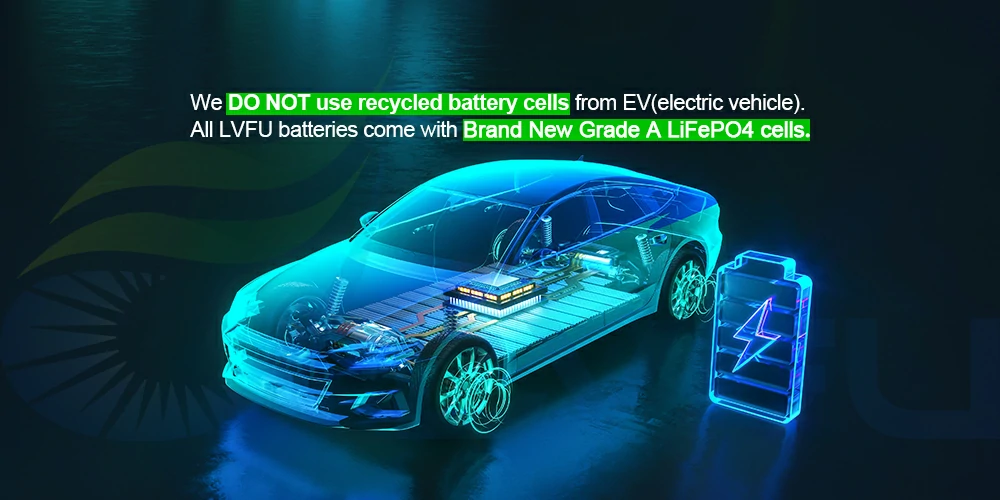
Given the uncertainties surrounding the safety and long-term returns of second-life batteries, LVFU adheres to a more reliable product strategy. We strictly source brand-new, Grade A cells from top-tier domestic manufacturers, completely avoiding any second-life cells. By doing so, we ensure consistent performance and safety from the very beginning. Furthermore, we offer high-quality warranty services, allowing every customer to use our products with confidence and maintain them smoothly—free from worries about potential battery risks or the added burden of later maintenance.
