

Hi everyone!
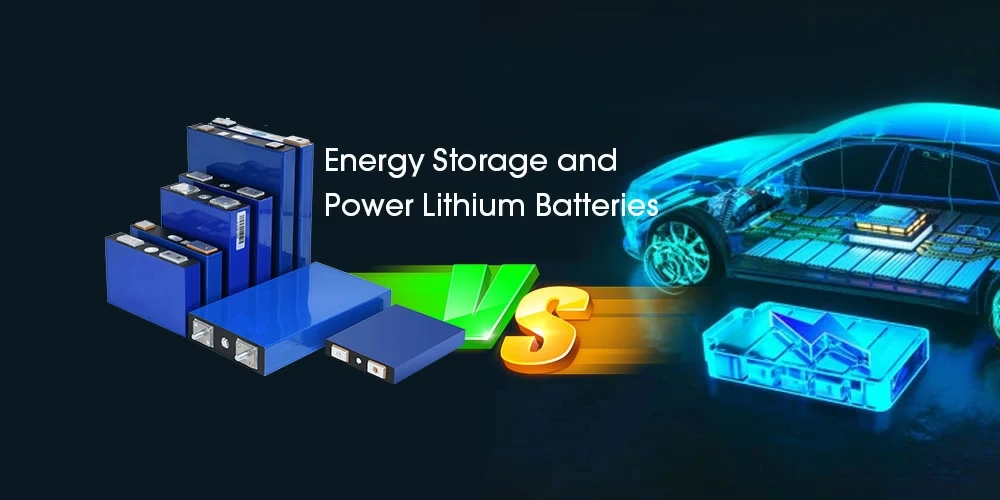
Today, let’s talk about lithium batteries. Many people might not clearly distinguish between energy storage batteries and power batteries, thinking they’re pretty much the same. But in reality, from design goals to actual applications, the differences between them are quite significant. Having worked in this field for some time, let me walk you through the key distinctions.
First, the most obvious difference: capacity is not the same.
If you take a fresh battery and test it with a discharge meter, you’ll quickly see the point. Typical power lithium batteries don’t actually have a very high capacity on their own, while energy storage lithium battery packs are designed to be true “capacity sponges” — their capacity is much higher. Why is that? You’ll understand after reading the following points.
Most importantly, they’re built for completely different jobs.
Think of it like comparing an off-road vehicle to a city bus — they’re designed for different roads.
- Power batteries are like “athletes.” They’re mainly used where power and movement are needed: for example, in electric vehicles, e-bikes on the road, and various power tools. They’re even used in some substations to deliver high instantaneous currents for switching operations — a demanding task.
- Energy storage batteries, on the other hand, act more like “large power banks” or “energy reservoirs.” Their main stage is power plants — think of those large container-like systems next to hydro, wind, or solar farms. Their job is to “absorb” excess electricity when it’s available and “release” it during peak demand, helping to balance grid frequency and manage loads. They’re also used in places that require stable, long-term power supply, like communication base stations, medical devices, or security systems.
Because their roles differ, the types of batteries used often vary too.
For energy storage stations, safety and cost are top priorities. That’s why lithium iron phosphate (LFP) batteries, known for their long lifespan and strong safety profile, are the mainstream choice here. Newer technologies like semi-solid-state batteries are also being explored. For some very large or older installations, lead-acid or lead-carbon batteries might still be used for cost reasons.
In the power battery space, especially for EVs, energy density and performance in cold weather matter more. So alongside LFP batteries, ternary lithium batteries hold a significant share of the market — largely because they help vehicles maintain better range in winter. It’s all about balancing different needs for different scenarios.
Lastly, they’re “trained” for completely different physical demands.
You can think of power batteries as sprint and weightlifting athletes:
- Strong burst performance: They need to support fast charging rates and high power output.
- Durability: They must withstand vibrations and shocks in moving vehicles.
- Travel light: They strive for the highest energy density within strict size and weight limits to extend driving range.
- Safety first: This is the bottom line — nothing can compromise safety.
Meanwhile, energy storage batteries are more like marathon runners or long-term guardians: - Endurance above all: The key goal is long cycle life, often aiming to operate reliably for 15 years or more.
- Team consistency: An energy storage system contains thousands of cells — consistency across all cells matters more than exceptional performance from any single one. No “weak links” allowed.
- Cost-effectiveness: Material choices emphasize long-term stability, low expansion rates, and ultimately lowering the cost per kilowatt-hour over the system’s entire lifespan.
To wrap up: Simply put, power batteries are designed for instantaneous power — efficiently releasing energy while on the move. Energy storage batteries are designed for energy throughput — storing and discharging energy over the long term, with stability and low cost as key goals in stationary applications.
I hope this comparison helps clarify things. If you’d like more insights on energy-related topics, feel free to keep following LVFU New Energy for updates.
