

EMS (Energy Management System) acts as the brain of any energy storage system. It does not generate or store power, but it controls everything—from monitoring battery status and managing charge/discharge cycles to optimizing energy costs and ensuring safety. Working alongside BMS and PCS, EMS enables intelligent scheduling, fault detection, and grid interaction. Its cloud-edge architecture supports real-time data processing and remote control. EMS plays an essential role in generation-side, grid-side, and user-side storage, as well as in virtual power plants (VPP). In short, EMS determines whether a storage system delivers profit, safety, and long-term reliability.
What is EMS, and what does it actually control?
EMS stands for Energy Management System. It does not generate or store electricity, but it commands and coordinates everything. Essentially, it serves as the central hub that connects the grid, the user, solar PV, storage, and charging equipment. More importantly, EMS decides whether a storage system operates profitably, safely, and stably.
In practice, EMS monitors, schedules, and optimizes energy flows within the storage system. It works across a wide range of applications, including commercial and industrial (C&I) storage, grid-side storage, and virtual power plants.
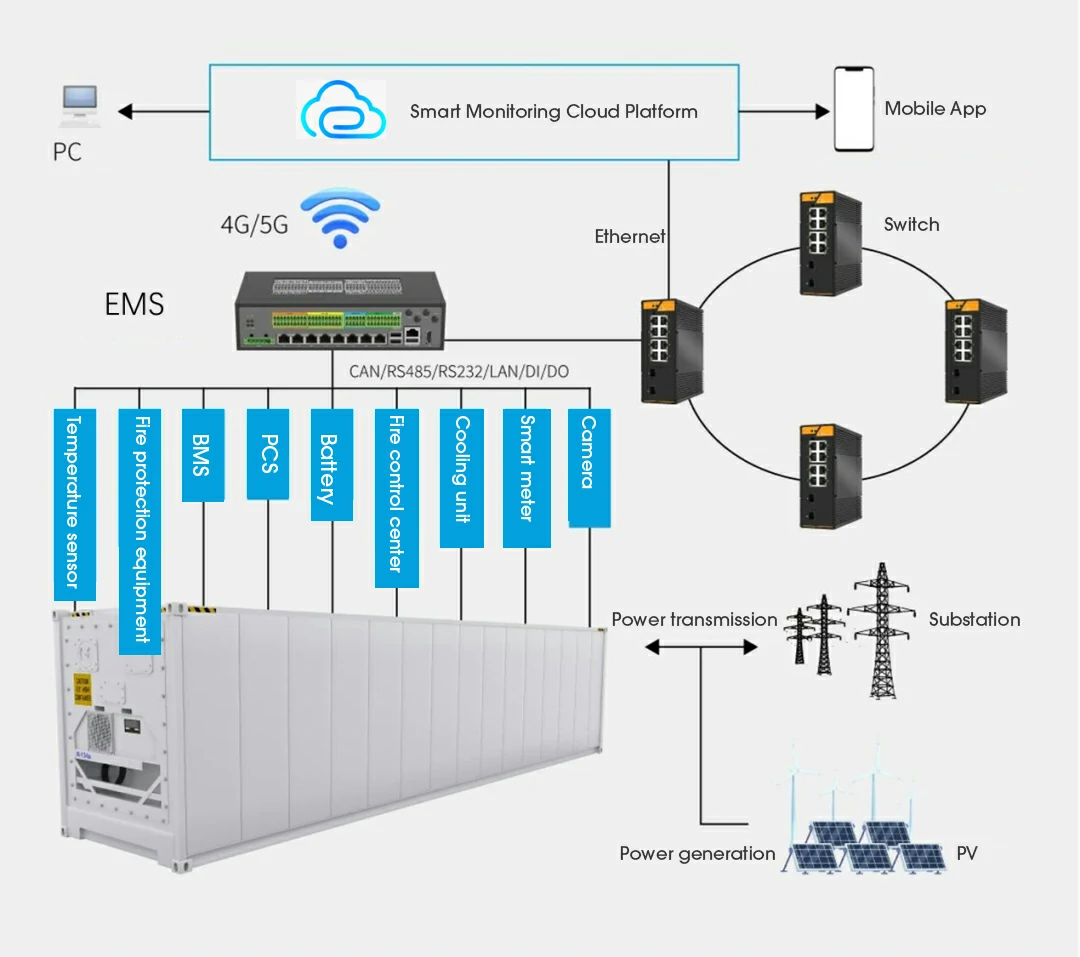
1. Key Equipment and Their Functions in the Storage System
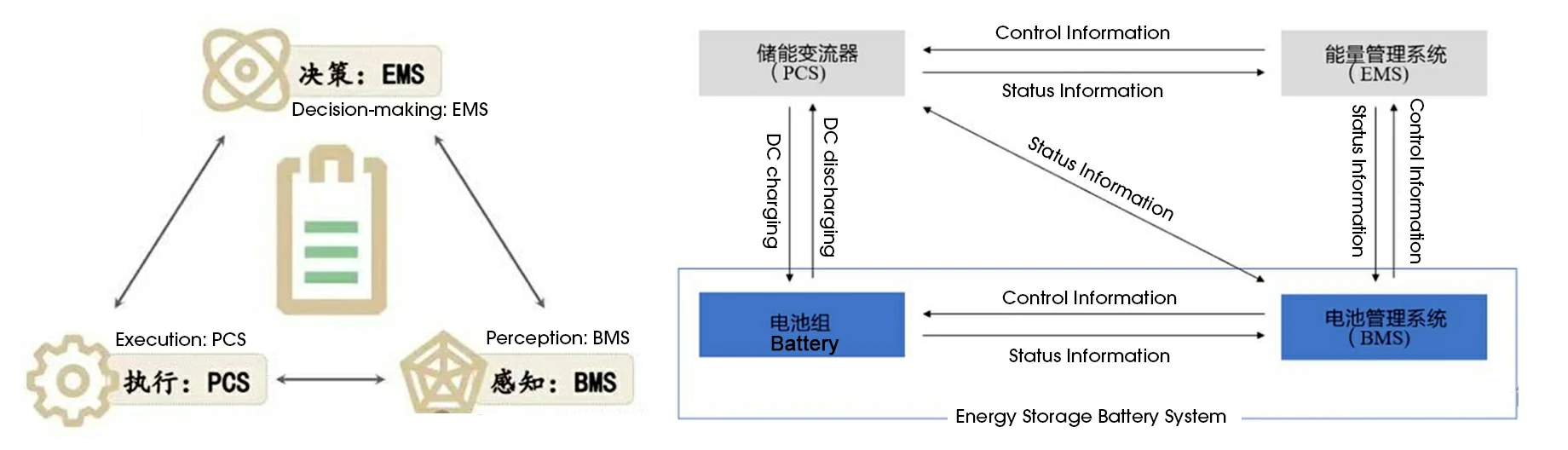
From a system architecture perspective, four main components form the backbone of any energy storage system: the battery, BMS, PCS, and EMS. Let us look at each one in turn.
- EMS (Energy Management System) – This component takes on the decision-making role. Specifically, it handles data collection, network monitoring, and energy scheduling.
- BMS (Battery Management System) – This component acts as the sensory system. Its primary responsibilities include monitoring battery status, evaluating performance, providing protection, and balancing individual cells.
- PCS (Power Conversion System) – This component executes the commands. Its main function involves controlling battery charging and discharging while performing the AC/DC conversion.
2. EMS System Architecture
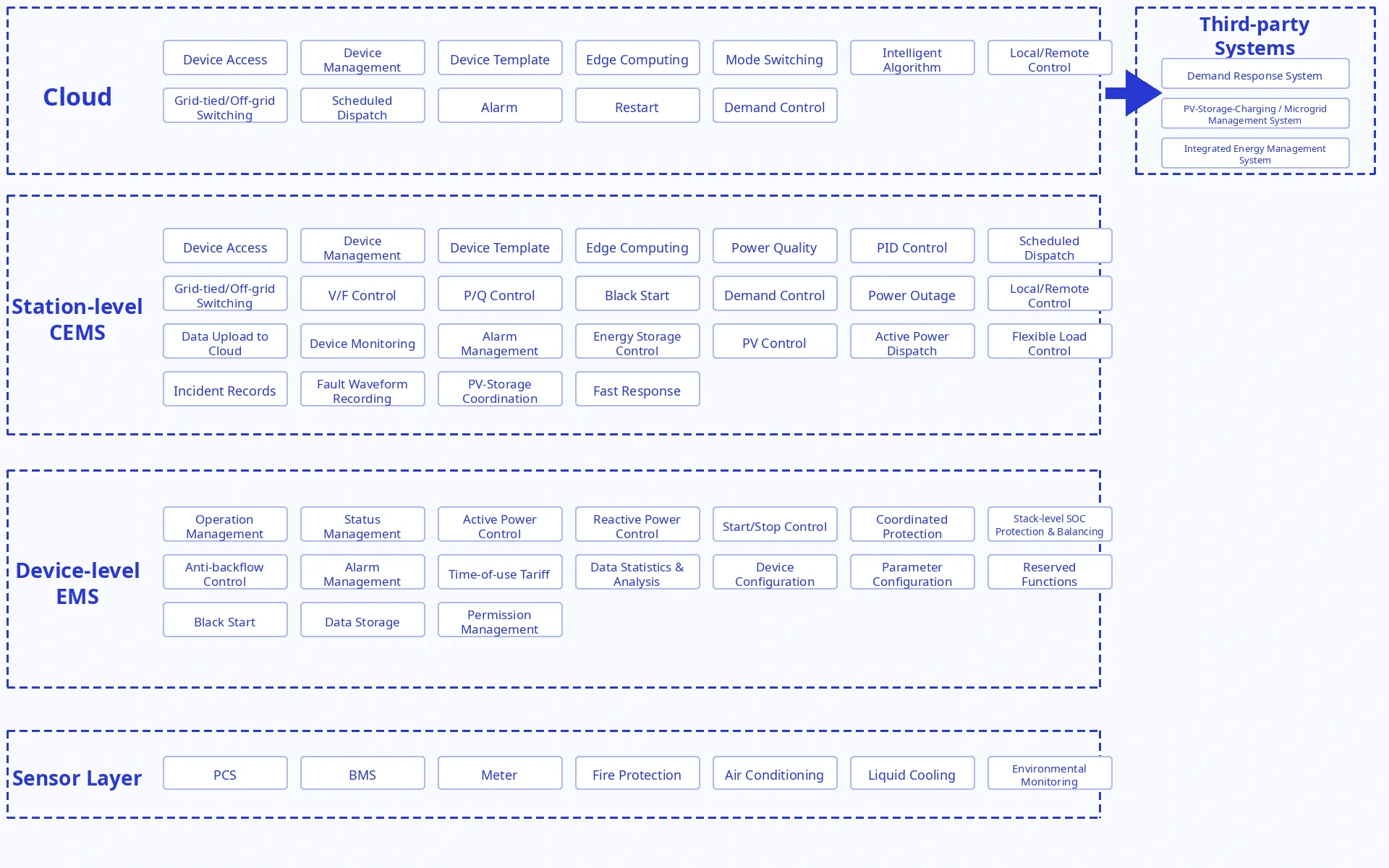
EMS architecture consists of four distinct layers. Let us walk through each one in detail.
1. Device Layer
This layer includes the physical hardware: battery cabinets, BMS, PCS, auxiliary control systems (such as air conditioning, fire safety, temperature and humidity sensors), and smart meters.
2. Communication Layer
EMS communicates with the device layer mainly through RJ45 and RS485 bus connections. For this purpose, the primary communication protocols include Modbus, IEC 104, and IEC 61850.
3. Edge Layer
This layer handles local data storage, energy scheduling strategies, safety warnings, thermal runaway management, and temperature control. In other words, it manages on-site intelligence.
4. Application Layer
This layer includes middleware, databases, and servers. The database system processes and stores data, recording both real-time and historical information while enabling historical data queries. Users interact with this layer through interfaces like mobile apps and web portals, which provide visualization and control functions for system operators.
EMS Cloud-Edge Collaborative Architecture
3. Core Capabilities of EMS
EMS delivers four main capabilities. Let us examine each one in detail.
1. Monitoring and Data Collection
To begin with, EMS uses sensors and metering devices to track energy generation, storage, and consumption in real time. It collects critical data, including battery charge/discharge status, temperature, voltage, and current.
2. Energy Scheduling and Control
Based on real-time energy demand and system operating conditions, EMS intelligently schedules and controls energy flows. For example, it decides when to charge or discharge the battery, switches between operating modes, and triggers emergency disconnections when needed.
Moreover, EMS now supports several advanced scheduling strategies, including:
- Coordinated scheduling with PV generation, EV chargers, and building loads – in this case, combining weather forecasts and user behavior modeling for AI-driven load prediction.
- Optimization based on time-of-use electricity pricing, load profile analysis, and revenue maximization models – consequently determining the best times to charge or discharge for arbitrage.
- Integration with virtual power plant platforms – enabling participation in AGC frequency regulation, reactive power control, and demand response programs.
3. Fault Detection and Safety Protection
In addition, EMS detects and alerts operators to abnormalities such as over-discharge, over-charge, or temperature excursions. This ensures the safe operation of the entire storage facility.
4. Data Analysis and Optimization
Finally, EMS applies advanced data analytics to process and analyze collected data. It identifies potential issues within the system and recommends targeted improvements. For instance, it builds battery health models and archives operational data to enable predictive maintenance and early fault warnings. Furthermore, it works with the BMS to assess State of Health (SOH), cycle life, and risk levels.
4. EMS + Storage: Application Scenarios
Let us now explore how EMS functions across different application scenarios.
✅ Generation-Side Storage
- Challenge: Renewable generation (solar and wind) is inherently intermittent and volatile. Large-scale grid integration can cause voltage and frequency fluctuations. Storage helps smooth these fluctuations and improve renewable energy utilization.
- EMS role: EMS provides power smoothing, enhances renewable absorption, and manages ramp rate control.
✅ Grid-Side Storageid-Side Storage
- Use cases: Frequency regulation, peak shaving, emergency backup, and isolated grid operation.
- EMS role: EMS delivers high-speed data acquisition and millisecond-level response. It also connects to the dispatch center for remote control.
✅ User-Side Storage (C&I)
- Use cases: Time-of-use arbitrage, demand charge management, and PV self-consumption optimization.
- EMS role: EMS tracks load curves in real time, intelligently decides discharge timing, and optimizes the overall electricity cost structure.
✅ Virtual Power Plants (VPP)
- Use cases: Aggregated dispatching and ancillary services across distributed storage sites.
- EMS role: EMS provides a unified aggregation and dispatch interface. It connects with VPP platforms to maximize market-based returns.
