

Key Takeaways
- A battery is simply a box that stores electricity and releases it when you need it — nothing more mysterious than that.
- A battery does not create energy. Current flows out when you discharge it and flows back in when you charge it.
- A home storage battery is a very large power bank: it stores the solar power you generate by day and releases it at night.
- Voltage, current, power, and energy map directly onto water pressure, water flow, flow rate, and total water delivered.
- Lithium iron phosphate (LFP) is the default chemistry for home storage — safe, long-lived (around 6,000 cycles), and low-cost.
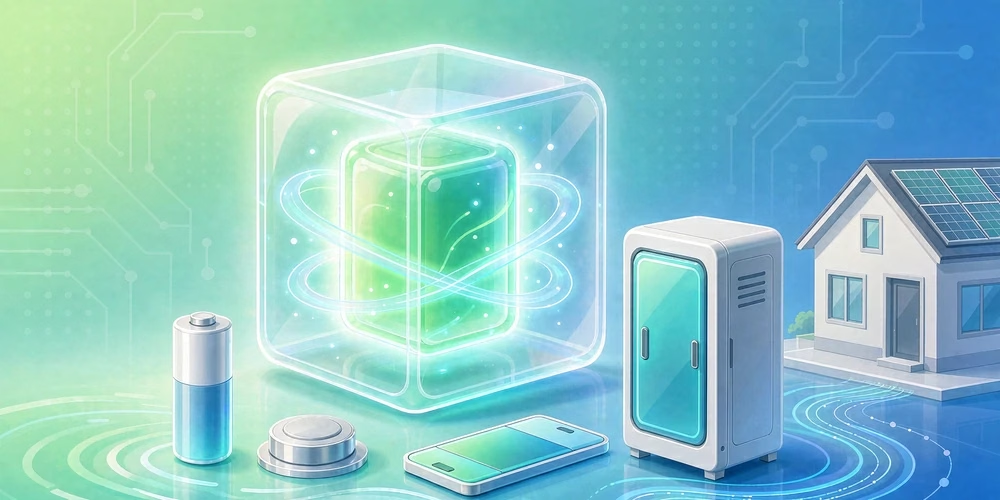
A Battery Is a Box That Stores Electricity
Start with the simplest definition you can give a customer: a battery is a box that holds electricity. You put energy in, you take it out when you need it, and that is the whole idea.
You already meet batteries every day, in wildly different shapes: AA cells in a flashlight; coin cells in a TV remote; lithium-ion packs in a phone; lead-acid batteries in a car or an e-bike; large battery racks in a home storage cabinet.
These products look nothing alike, yet they all do one job: store electrical energy in a container. The only real difference is size — and the engineering that comes with it.
How a Battery Works: Out When You Use It, Back In When You Charge
A battery works in two directions, and that is all there is to it. When you use it, current flows out of the box, lights a lamp, and drives a motor. When you charge it, current flows back in, and the box fills up again.
No fuel burns, and no new energy appears. The same electricity simply moves out and back.
It behaves exactly like a power bank
Your phone runs flat, so you plug in a power bank — and current flows from the power bank into the phone. Later the power bank itself runs flat, so you plug it into a charger — and current flows back into the power bank. Two directions, one container.
A home storage battery is a very large power bank
A home battery stores the electricity your PV panels produce during the day, then releases it at night to run the house. The principle never changes as the system scales up; only capacity, voltage, and safety engineering grow.
What Is Electricity? Think of Tap Water
Before you size any storage system, get four words straight: voltage, current, power, and energy. The tap-water analogy explains all four at once.
| Electrical concept | Water analogy | Plain explanation | Unit |
| Voltage | Water pressure | Higher pressure throws water farther; higher voltage pushes electricity harder | Volt (V) |
| Current | Water flow volume | A fatter pipe carries more water; a thicker cable carries more current | Ampere (A) |
| Power | Total outflow rate | Pressure × flow = output power; voltage × current = electrical power | Watt (W) |
| Energy | Total water delivered | Power × time = energy consumed, the number your meter counts | Kilowatt-hour (kWh) |
Put it in one line: electricity behaves like tap water — voltage is the pressure, current is the flow, power is how fast water leaves the tap, and energy is how much water you drew in total.
The Battery Family Tree: 100 Years from Dry Cells to Home Storage
| Battery type | Common applications | Characteristics | Suitable for home storage? |
| Dry cell | Remotes, flashlights | Single-use, cannot be recharged | ✕ Too small and not rechargeable |
| Lead-acid | Car batteries, e-bikes | Cheap but heavy, short life (around 300 cycles), polluting | ✕ Too heavy, too short-lived, phased out |
| NMC (ternary lithium) | Phones, electric vehicles | High energy density, but weaker safety and fire risk | △ Workable, but not recommended for home storage |
| Lithium iron phosphate (LFP) | Storage plants, home systems | Safe, long life (around 6,000 cycles), low cost | ✓ First choice for home storage |
| Sodium-ion | Next-generation technology | Good low-temperature performance, lower cost, still maturing | ○ On our future product roadmap |
Why LFP Wins for Home Storage
Chemistry choice is not a matter of fashion; it follows from where the battery sits and how long it must last. Safety comes first indoors. NMC packs more energy into the same weight, which is exactly what a phone or an EV needs — but in a cabinet bolted to a house wall, energy density matters far less than the risk of thermal runaway.
Cycle life decides the economics. A lead-acid bank rated at roughly 300 cycles needs replacing long before an LFP bank rated at around 6,000 cycles — so the cheaper sticker price rarely survives the decade.
Cost per stored kilowatt-hour favors LFP. LFP uses iron and phosphate instead of nickel and cobalt, so raw material stays cheap and the supply chain stays stable.
As a result, LVFU builds its home storage systems on LFP cells, and we reserve sodium-ion for future products where low-temperature performance and cost matter most.
Putting the Three Ideas Together
A battery is a box. It stores electricity and gives it back on demand — that definition covers a AA cell and a 15kWh home cabinet alike.
Electricity follows the water analogy. Voltage is pressure, current is flow, power is the outflow rate, and energy is the total volume delivered.
Chemistry decides the application. Dry cells and lead-acid belong in the past, NMC belongs in devices that must be light, and LFP belongs in stationary storage.
Once these three ideas are clear, every later decision — capacity, inverter matching, backup hours — becomes a calculation rather than a guess.
Frequently Asked Questions
Q: What is a battery in one sentence?
A battery is a container that stores electrical energy and releases it when a device needs power.
Q: Does a battery create electricity?
No. A battery stores energy and returns it. Charging moves current in; discharging moves the same current out.
Q:What is the difference between voltage and current?
Voltage is the electrical “pressure” that pushes charge through a circuit (volts); current is the rate of flow (amperes).
Q:What is the difference between power (W) and energy (kWh)?
Power is how fast energy moves at a moment (W); energy is the total delivered over time (kWh). 1kW × 3h = 3kWh.
Q:Which battery type is best for home energy storage?
Lithium iron phosphate (LFP) — the best balance of safety, cycle life (around 6,000 cycles), and cost.
Q:Why not use NMC batteries for home storage?
NMC offers higher energy density but weaker thermal stability, so fire risk is higher; indoors, LFP’s safety margin outweighs the weight advantage.
