

Many buyers focus on amp-hours (Ah) or kilowatt-hours (kWh) when they compare LiFePO4 energy storage batteries. However, a battery can store enough energy to run for several hours and still fail to start an air conditioner, refrigerator, water pump, compressor, or other motor-driven equipment.
The problem usually does not involve the total amount of energy in the battery. Instead, the system may not deliver enough current and power at the moment the equipment starts.
In simple terms, battery capacity determines how long a system can run, while power determines how large a load the system can operate at one time. Motor-driven equipment also requires enough surge power to start.
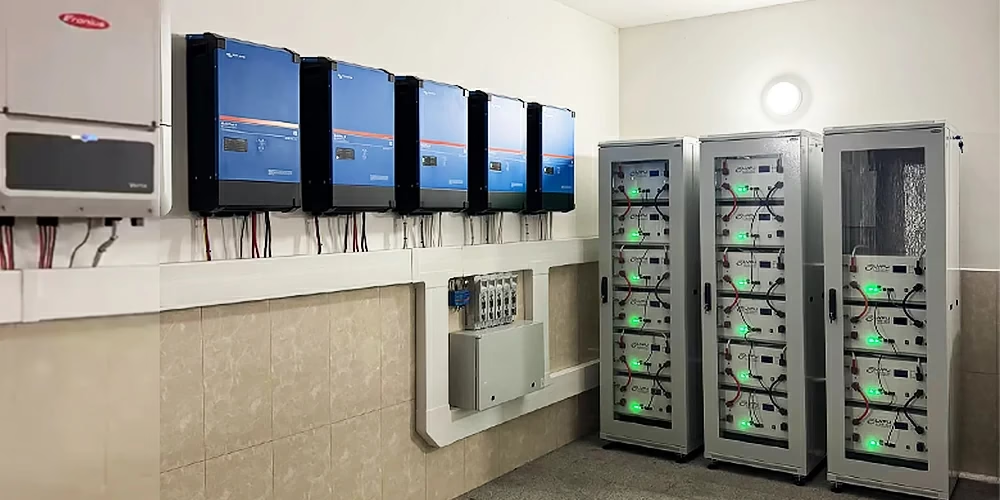
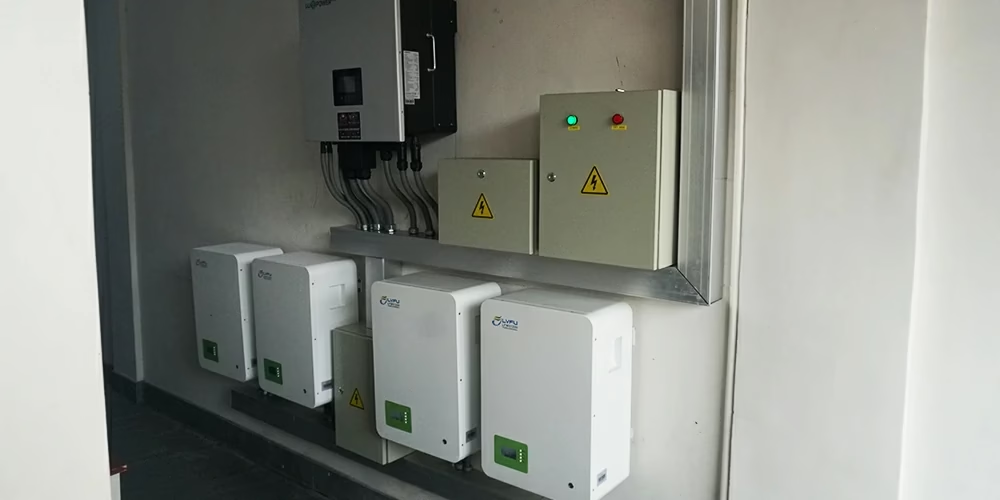
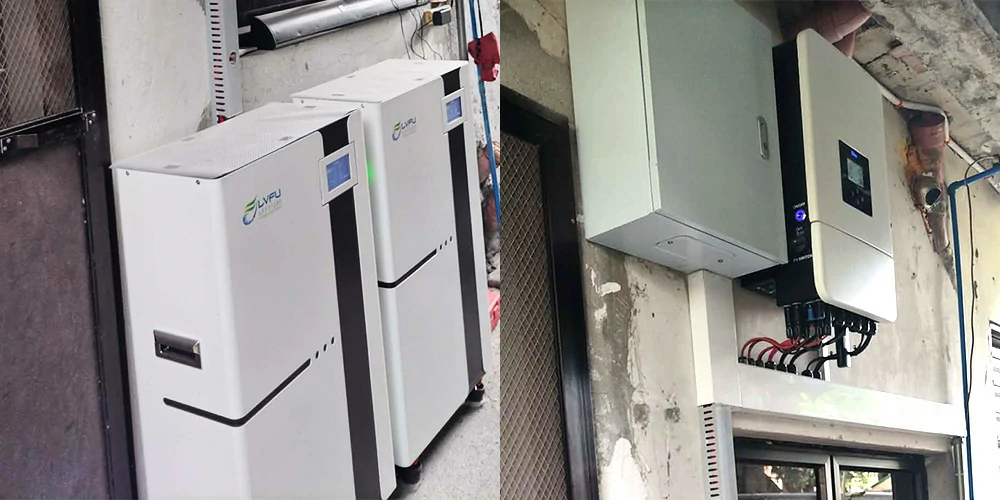
Power vs. Capacity: What Is the Difference?
Power Determines the Output Rate
Power measures how quickly a system transfers energy. Manufacturers usually express power in watts (W), kilowatts (kW), or megawatts (MW).
A battery system normally has two important power ratings:
- Continuous or rated power: The power that the system can deliver for an extended period.
- Peak or surge power: The higher power that the system can deliver for a short period, usually during equipment startup.
For example, a 3 kW inverter can normally operate a load of approximately 3 kW continuously. However, if an air conditioner requires 6 kW of surge power when its compressor starts, the inverter may shut down because of overload—even if the connected battery stores 20 kWh.
Therefore, a system must match both the equipment’s running power and its startup power.
Capacity Determines the Available Energy
In energy storage applications, capacity usually refers to the amount of energy that the battery can store or release. Manufacturers express energy capacity in watt-hours (Wh), kilowatt-hours (kWh), or megawatt-hours (MWh).
You can estimate runtime with the following formula:
Estimated runtime (hours) ≈ Usable battery capacity (kWh) × inverter efficiency ÷ load power (kW)
For example, a 10 kWh battery supplying a steady 2 kW load through an inverter with 90% efficiency can theoretically run that load for approximately 4.5 hours:
10 kWh × 90% ÷ 2 kW = 4.5 hours
However, this calculation only estimates runtime. It does not prove that the battery can start the equipment. Startup performance also depends on the battery’s discharge current, the BMS, the inverter, the wiring, and the equipment’s surge requirement.
Why Can a High-Capacity LiFePO4 Battery Fail to Run High-Power Equipment?
1. The Battery Cannot Deliver Enough Discharge Current
Power depends on voltage and current:
Power (W) = Voltage (V) × Current (A)
Suppose a 48 V battery system supplies a 5 kW load. The theoretical battery-side current is approximately:
5,000 W ÷ 48 V ≈ 104 A
The battery must supply even more current after you account for inverter losses. In practice, the required current may exceed 115 A.
If the battery supports only 100 A of continuous discharge current, the system may reduce its output, trigger low-voltage protection, or shut down. The battery may still have plenty of stored energy, but it cannot release that energy quickly enough.
2. The Battery’s C-Rate Is Too Low
The C-rate describes the charging or discharging current relative to the battery’s rated capacity.
- 0.5C usually corresponds to 100 A.
- 1C usually corresponds to 200 A.
Always confirm the actual continuous and peak ratings in the manufacturer’s datasheet because different battery models use different limits.
You can estimate the battery-side continuous power with this formula:
Approximate continuous power = Nominal voltage × Battery capacity (Ah) × Permitted continuous C-rate × System efficiency
Consider a 51.2 V, 200 Ah battery:
- Nominal energy: 51.2 V × 200 Ah = 10.24 kWh
- Continuous discharge rate: 0.5C
- Continuous current: 200 Ah × 0.5C = 100 A
- Theoretical battery-side power: 51.2 V × 100 A = 5.12 kW
After inverter and wiring losses, the available AC output will be lower than 5.12 kW.
Consequently, a 10 kWh battery does not automatically equal a 10 kW battery. Capacity and power describe different performance characteristics.
3. The BMS Activates Overcurrent or Undervoltage Protection
The Battery Management System (BMS) monitors cell voltage, current, temperature, and state of charge. When the equipment starts, the BMS may detect a current spike and disconnect the battery to protect the cells.
In addition, a high current can create voltage drop across the battery, cables, connectors, fuses, and relays. The BMS or inverter may then detect undervoltage and stop the system.
Common causes include:
- A BMS continuous-current rating that is too low;
- A peak-current duration that is too short;
- Cables that are too thin or too long;
- Loose or corroded terminals;
- Incorrectly sized fuses or breakers;
- A high-resistance connection;
- Battery aging or cell imbalance.
The BMS does not create a power problem. Instead, it reveals that the battery or the rest of the system cannot safely meet the load requirement.
4. The Inverter Lacks Continuous or Surge Power
Most LiFePO4 batteries supply AC equipment through an inverter. As a result, the battery and inverter must work together. The weaker component limits the usable system power.
When you select an inverter, check all of the following:
- Continuous output power;
- Peak or surge output power;
- Surge duration;
- Maximum DC input current;
- Compatibility with the battery BMS;
- Required communication protocol.
Resistive loads, such as electric heaters, usually operate close to their nameplate power. In contrast, inductive loads—such as refrigerators, air conditioners, water pumps, compressors, and cutting tools—may draw several times their running current during startup.
Therefore, an inverter may have enough continuous output power but still fail to start the equipment if its surge rating is too low.
5. Temperature, Low State of Charge, and Aging Reduce Available Power
A battery does not deliver the same power under every operating condition.
First, low temperatures may cause the BMS to restrict charging or discharging current. Second, a low state of charge (SoC) can make the battery voltage fall more sharply under load. Finally, battery aging increases internal resistance, which creates greater voltage sag during high-current events.
For this reason, a battery that starts a motor successfully at 100% SoC may fail to start the same motor at a low SoC or in cold weather.
How to Select the Right LiFePO4 Energy Storage System
Step 1: Calculate Capacity and Power Separately
Start by calculating the required capacity. List the equipment, its operating power, and the expected runtime. Then account for inverter efficiency, cable losses, usable depth of discharge, temperature, and a reasonable safety margin.
Next, calculate power independently. Check the maximum simultaneous load, the startup surge, and the battery-side current.
A properly matched system should satisfy at least these conditions:
- Battery continuous power ≥ the inverter’s required DC input power
- Inverter continuous power ≥ the load’s running power
- Inverter peak power ≥ the load’s startup surge power
The system must also stay within the battery’s voltage, current, temperature, and BMS limits.
Step 2: Look Beyond Ah and kWh
When you compare batteries, review more than the capacity label. Confirm the following specifications:
- Nominal voltage;
- Usable energy capacity;
- Continuous charge and discharge current;
- Peak discharge current;
- Peak-current duration;
- Continuous and peak C-rate;
- BMS protection limits;
- Recommended inverter power;
- Operating temperature range;
- Communication compatibility;
- Parallel-connection capability;
- Power limits when multiple batteries operate in parallel.
This approach prevents a common mistake: choosing a battery with sufficient runtime but insufficient power output.
Troubleshooting Checklist: What to Check When the Battery Cannot Run the Equipment
1. Determine Whether the System Fails at Startup or During Operation
If the system shuts down immediately after you start the equipment, first check the startup surge, inverter peak power, BMS overcurrent protection, and voltage sag.
If the system runs for several minutes and then stops, check the continuous power rating, heat dissipation, operating temperature, battery SoC, and inverter overload protection.
This distinction helps you focus on the correct part of the system.
2. Record Voltage, Current, and Alarm Data During Startup
Monitor the battery terminal voltage, battery current, and inverter alarm code when the equipment starts. Do not rely only on the battery’s no-load voltage because the battery may show a normal voltage before the load begins.
If the voltage drops sharply, ask a qualified technician to inspect:
- Cable cross-section and length;
- Cable lugs and connectors;
- Fuses, breakers, and relays;
- Terminal tightness;
- Battery internal resistance;
- BMS and inverter settings.
3. Do Not Bypass the Protection System
Always compare the battery datasheet, BMS parameters, inverter manual, and equipment nameplate. Never raise BMS protection thresholds or disable undervoltage protection simply to operate a larger load.
A protection event usually indicates a mismatch involving current, power, wiring, temperature, or battery condition. Removing the protection may damage the battery or create a safety risk.
Frequently Asked Questions
Does a larger LiFePO4 battery capacity always mean higher power output?
No. Capacity and power measure different characteristics. The number of cells in parallel, the BMS, the cables, the connectors, the inverter, and the permitted C-rate all affect power output.
How many watts can a 100 Ah battery provide?
You cannot determine the answer from 100 Ah alone. You also need the battery voltage, permitted discharge rate, BMS current limit, inverter efficiency, and load surge requirement.
For example, a 100 Ah 48 V battery stores much more energy than a 100 Ah 12 V battery. However, the actual output still depends on the battery’s current rating and the inverter’s power limits.
Can a 10 kWh battery run a 10 kW load?
Not necessarily. A 10 kWh battery may support only a few kilowatts of continuous output if its C-rate or BMS current limit is low. You must check the battery’s continuous power rating and the inverter’s output rating.
Why does a battery run a small load but not start a motor?
Motors, compressors, pumps, and air conditioners usually require a high startup surge. The inverter may support the equipment’s running power but fail to provide the short-term surge power required to start it.
Does connecting batteries in parallel increase power?
Parallel connection can increase total capacity and, when the system supports it, total available current. However, the battery manufacturer must approve the configuration, and the cables, fuses, BMS communication, and inverter must support the combined system.
What information should I provide when requesting a battery solution?
Provide the equipment list, running power, startup power if available, expected runtime, daily operating hours, battery voltage preference, solar system size, inverter model, and whether you need backup power. A load profile or equipment nameplate will help the supplier recommend a more accurate solution.
Conclusion: Match Capacity, Power, and Surge Capability
A LiFePO4 battery can have enough capacity and still fail to run high-power equipment. There is no contradiction: capacity determines how long the system can supply energy, while power determines how quickly the system can deliver that energy.
Motor-driven equipment also requires enough startup surge power. Therefore, correct system sizing must consider the battery’s continuous discharge current, C-rate, BMS limits, inverter continuous and peak power, cable voltage drop, operating temperature, SoC, and load characteristics.
When these specifications match, the energy storage system can provide both long runtime and reliable high-power performance.
Need help selecting a LiFePO4 battery and inverter combination? Contact LVFU Energy and share your load list, target runtime, inverter model, and project requirements for a preliminary energy storage recommendation.
