

Key Takeaways
Three chemistries compete for your home battery: LiFePO4 (LFP), NMC/NCA (ternary lithium), and sodium-ion (Na-ion).
LFP wins on the two numbers that matter most indoors: safety and cycle life — ≥6,000 cycles versus 2,000–3,000 for NMC
NMC packs more energy per kilogram (250–300 Wh/kg), which is why it dominates EV power batteries, not home cabinets.
Sodium-ion is the honest “rising star”: excellent low-temperature performance (≈90% capacity at −20°C) and low cost, but it is still ramping up mass production.
Choose by use case, not by hype: for a battery that sits on your wall for 15+ years, LFP remains the first choice.
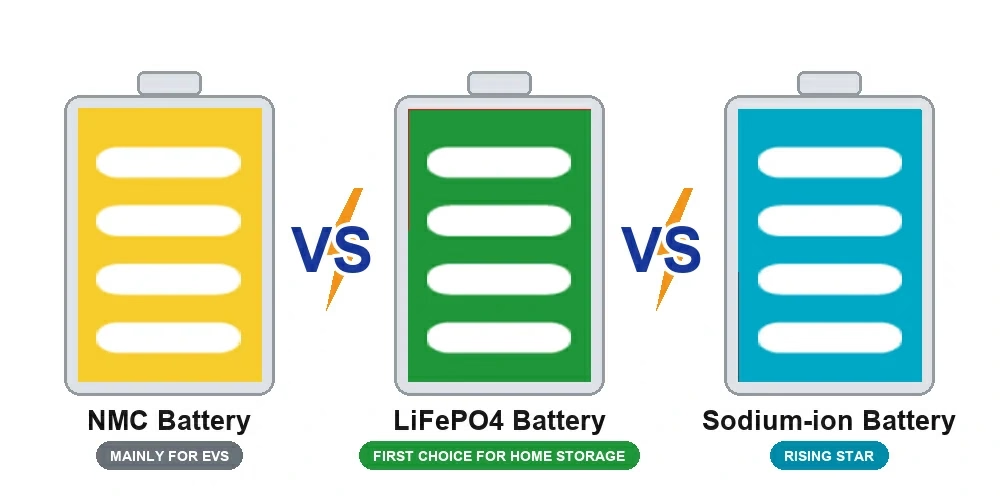
Meet the Three Contenders
Before comparing numbers, learn who is who.
LiFePO4 (LFP) — lithium iron phosphate. The chemistry this series focuses on, and the one inside most home storage cabinets today.
NCM / NCA (ternary lithium) — lithium nickel manganese cobalt oxide (or nickel cobalt aluminium). It trades some safety and lifespan for higher energy density, which suits cars far better than walls.
Sodium-ion (Na-ion) — the newcomer. It swaps lithium for abundant, cheap sodium. It does not yet match LFP across the board, but it is improving fast.
The Full Comparison Table
Here is the head-to-head comparison, using typical publicly available cell specifications.
| LiFePO4 (LFP) | NMC | Sodium-ion | ||
| Nominal voltage | 3.2V | 3.6–3.7V | 3.0–3.3V | |
| Energy density | 160–180 Wh/kg | 250–300 Wh/kg | 120–160 Wh/kg | |
| Cycle life | 6,000+ cycles | 2,000–3,000 cycles | 4,000+ cycles (improving) | |
| Safety | High (strong thermal stability) | Lower (prone to thermal runaway) | High (sodium does not plate lithium) | |
| Low-temperature performance | ≈70% capacity at −20°C | ≈80% capacity at −20°C | ≈90% capacity at −20°C | |
| Cost | Medium (tracks lithium carbonate prices) | High (contains cobalt and nickel) | Low (abundant sodium resources) | |
| Fit for home storage | ★★★★★ — the first choice | ★★☆ — mainly EV power batteries | ★★★ — rising star, ramping up production |
Data source: publicly available industry cell specifications. Sodium-ion cells are still in the mass-production ramp-up stage; final performance depends on each manufacturer’s product roadmap.
Now read the table the way a buyer should — not row by row, but by asking what each row means for a battery that hangs on your wall for a decade or more.
What Each Row Actually Means for You
Safety: the row that decides everything indoors
A home battery lives inside your garage or utility room, next to your family. Consequently, thermal stability is not a nice-to-have — it is the entry ticket. LFP’s olivine structure resists thermal runaway strongly, and sodium-ion performs well here too because sodium chemistry does not plate metallic lithium. NMC, by contrast, carries a lower thermal-runaway threshold because of its nickel-rich composition. This single row already explains most of the market’s preference.
Cycle life: the row that decides your cost per kWh
Cycle life converts directly into money. Run the math on daily cycling: at 6,000+ cycles, an LFP battery serves roughly 16 years before fading to 80% capacity — as we calculated in Part 2. An NMC pack rated at 2,000–3,000 cycles reaches that point in 6–8 years, so you would replace it two or three times over the same period. Sodium-ion currently sits in between at 4,000+ cycles and is still improving. Over a 15-year horizon, cycle life matters far more than any spec-sheet headline number.
Energy density: the row that matters least at home
Here is the counter-intuitive part. NMC’s 250–300 Wh/kg looks impressive, and in an electric car it genuinely is — every kilogram saved extends driving range. However, your battery cabinet sits on the floor, where nobody counts kilograms. In practice, energy density decides whether a battery fits in a car, not whether it fits in a house. That is why NMC’s best row is also the one home buyers should mostly ignore.
Low-temperature performance: LFP’s honest weak spot
Give credit where it is due: LFP is the weakest of the three in the cold, holding only about 70% capacity at −20°C, while sodium-ion holds roughly 90%. Does this disqualify LFP? In most cases, no — because a home battery is usually installed indoors or in an insulated enclosure, where temperatures stay far milder than −20°C. Still, if you live in an unheated shed in a cold climate, this row deserves a place in your decision.
Cost: medium today, and trending the right way
LFP cost sits in the middle today, mainly because it still tracks lithium carbonate prices. NMC costs more because cobalt and nickel are expensive. Sodium-ion promises the lowest cost of all, thanks to abundant sodium resources — but its large-scale economics are still being proven as production ramps up. Therefore, treat sodium-ion’s cost advantage as a forecast, not a present-day fact.
Why LFP Wins for Home Storage — and Where Sodium-Ion Fits
Indoors, safety comes first — LFP’s thermal stability is the baseline requirement, not a bonus.
On a wall, longevity pays the bills — 6,000+ cycles make LFP the cheapest electricity per kWh over 15 years.
At home, energy density barely matters — which removes NMC’s main advantage from the table.
In cold garages, LFP is good enough — especially once the battery sits in a conditioned indoor space.
NMC remains a superb chemistry for electric vehicles, where every kilogram counts. Sodium-ion is a genuine rising star — watch it closely for cold climates and cost-sensitive markets, but verify mass-production maturity before you bet a 15-year installation on it. For a battery that quietly serves your household for decades, LiFePO4 stays the first choice — which is exactly why LVFU builds its home storage line on LFP cells.
A Buyer’s Rule of Thumb
Before you compare brands, compare chemistries — and match the chemistry to where the battery will live.
Wall-mounted indoor battery, daily cycling, 10–15 year horizon → LiFePO4.
Electric vehicle or weight-critical application → NMC/NCA.
Very cold, cost-driven, or future-proofing experiment → watch sodium-ion as it matures.
Frequently Asked Questions(FAQ)
Which battery chemistry is safest for home use? LiFePO4 and sodium-ion both show high thermal stability. LFP is the more proven option with years of mass deployment, while sodium-ion safety is promising but still accumulating field history.
Why do electric cars use NMC but home batteries use LFP? Cars carry their batteries, so energy density (250–300 Wh/kg for NMC) directly extends driving range. Home batteries sit on the floor, so cycle life and safety outweigh weight savings.
Is sodium-ion better than LiFePO4? Not overall — yet. Sodium-ion leads in low-temperature performance (≈90% at −20°C) and raw material cost, but LFP still leads in cycle life, safety track record, and production maturity.
How many cycles does a home battery need? For daily cycling over 10–15 years, aim for 4,000+ cycles; LFP’s 6,000+ rating provides comfortable headroom even with deeper daily discharge.
Does LFP work in cold climates? Yes, with caveats: expect roughly 70% capacity at −20°C. Install the battery indoors or in an insulated, temperature-managed space, and the cold-weather penalty shrinks to almost nothing.
Will sodium-ion replace LiFePO4 in home storage? Not in the short term. Sodium-ion is still ramping up mass production. It may earn a share in cold or cost-sensitive segments, but LFP’s proven 6,000+ cycle lifespan keeps it the default choice today.
