

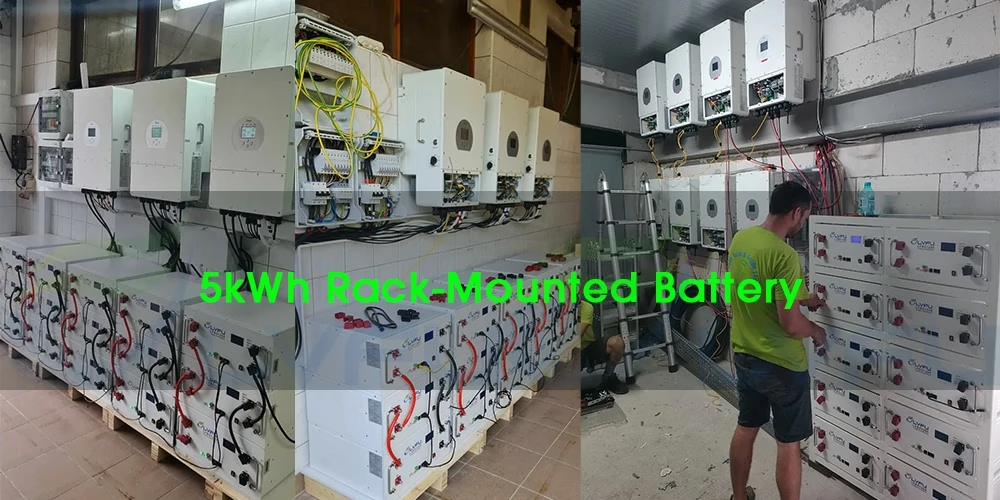
When you’re looking at home energy storage options, the 5kWh rack-mounted battery comes up a lot. From what I’ve seen with installations, this setup actually solves real problems for people.
What Makes It Stand Out: Key Features & Benefits
Simply put, it’s a standardized energy storage module. It uses LiFePO4 (lithium iron phosphate) technology – most people choose it because it’s relatively safe. For most households, 5 kilowatt-hours is just the right amount – enough for daily use without taking up too much space.
Here are the key things to know:
First, installation is genuinely straightforward
Since it’s designed for standard rack dimensions, you can stack them like building blocks. I’ve worked with clients who have tight equipment rooms, and this vertical installation approach works really well. When you need to expand capacity later, you just add modules – no rewiring required.
Second, it lasts longer than you might think
LiFePO4 batteries can indeed handle over 6,000 cycles, but keep in mind that’s under lab conditions. In actual daily use with deep discharges, you can realistically expect 8-10 years. Compared to lead-acid batteries that need replacing every 2-3 years, this works out better financially in the long run.
Third, it has built-in protection
Each battery has a BMS (Battery Management System) working in the background. It monitors each cell in real time, automatically balances charge levels, and prevents overcharging or excessive discharging. Think of it like having a maintenance manager looking after your battery’s health.
What to Really Check When Choosing
When picking one of these batteries, you’ll see a lot of technical jargon on the spec sheet. Let me tell you what actually matters based on what usually goes wrong in real installations.
Read the fine print on the specs:
- That “5kWh” rating is what the battery can hold total. But the amount you can actually use? Usually 4.5-4.8 kWh. Manufacturers lock away that last bit as a safety buffer to protect the battery’s lifespan. I’ve had clients call me confused when their system shows 95% charged but won’t discharge further – this is why.
- Go with 48V or 51.2V models. Right now, those are the sweet spots. Trying to mix a less common voltage with a standard home inverter often ends with expensive adapters or a system that won’t talk to each other.
- Measure your cabinet twice, especially the depth. I can’t tell you how many times I’ve arrived on site with a perfect battery, only to find the client’s existing cabinet has internal brackets, cable management bars, or a weird back panel that steals just enough space to make it a no-go.
Three Non-Negotiables Before You Install:
- Compatibility isn’t a suggestion.Email your inverter’s support team with the exact battery model number. Get their confirmation in writing. Last year, I spent three frustrating days troubleshooting a system where the battery and inverter were from “compatible” brands, but a firmware mismatch meant they refused to communicate.
- Ventilation space is a lifesaver. That 5-10 cm clearance around the battery isn’t just for airflow; it’s for safety inspections and future maintenance too. Packing it in tight might look neat, but it traps heat and makes it impossible to check terminal connections later.
- Think ahead with your wiring.Even if you’re starting with one unit, install the correct gauge wiring and communication cables for two or three. The extra cost upfront is minimal compared to the hassle and expense of pulling new wires through finished walls a year from now when you decide to expand.
Where It Actually Makes Sense
For a home with solar panels, this setup just works. You store your excess solar generation during the day instead of selling it back to the grid for pennies, and use it at night when rates are high. In areas with big price differences between peak and off-peak hours, the savings can cover the system’s cost surprisingly fast.
For a small business, like the corner store or a cafe, it’s about avoiding the “oh no” moment. A single power outage can mean lost inventory, angry customers, and a hit to your reputation. Having two or three of these units as backup keeps your lights, fridges, and cash registers running long enough to ride out most common outages without breaking a sweat.
A Few Installation Truths Everyone Forgets:
- Find a cool, dry spot away from your water heater or furnace. Heat is the number one enemy of battery longevity.
- The grounding wire isn’t optional decoration. A proper ground is your last line of defense. It’s the one thing I always double-check, because even professional crews can get in a rush and give it a sloppy connection.
- That first full charge isn’t just a formality. It “wakes up” the battery management system and calibrates its understanding of 0% and 100%. Skipping it can lead to inaccurate battery readings down the line.
So, the real advantage here isn’t just technology—it’s simplicity. You get a reliable, set-it-and-forget-it component. And if you can stretch your budget for a brand with a solid reputation, you’re also buying a direct line to competent support when you need it.
Look, 5 kilowatt-hours might not sound impressive on paper when your home uses several times that each day. But in a pinch, that stored power is what keeps your Wi-Fi on during a storm, your freezer cold during a blackout, and gives you one less thing to worry about. That’s the real value.
