

What is C-rate?
C-rate is a unit that describes how fast a battery is charged or discharged relative to its rated capacity. 1C means the battery can be fully charged or discharged in 1 hour at a constant current. 0.5C means the battery needs 2 hours to fully charge or discharge.
How 0.5C vs. 1C C‑rates impact C&I peak shaving and frequency regulation
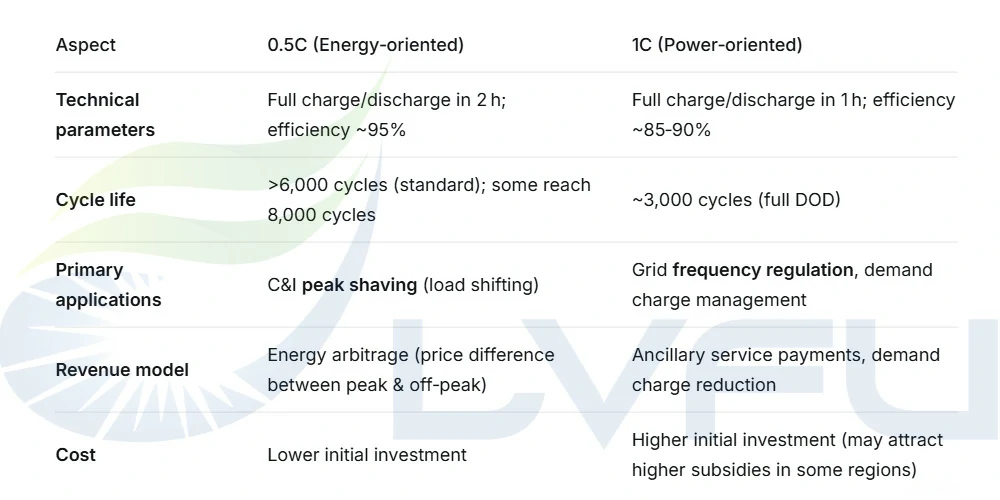
Choosing between 0.5C and 1C is essentially a trade‑off between short‑term revenue and long‑term stability.
0.5C system – Advantages: high safety, long cycle life (>6,000 cycles), and high reliability. It is the first choice for C&I users seeking stable, long‑term returns. In peak shaving, it perfectly matches the “two charges / two discharges” strategy common in many regions, maximising arbitrage profit by storing cheap off‑peak energy and using it during peak hours.
1C system – Advantages: high power output and fast response (seconds). It suits users who want to participate in high‑frequency, high‑value frequency regulation services for extra revenue. However, cycle life (~3,000 cycles) is significantly lower than that of a 0.5C system, and it demands a more advanced BMS and thermal management.
From a financial perspective, the choice is a clear business decision:
Different revenue models
A 0.5C system mainly earns through peak‑valley arbitrage: charging during low‑price periods and discharging during high‑price periods. Profit depends directly on the price gap.
A 1C system can earn extra income by participating in ancillary services (e.g., fast frequency response). Successful examples exist in regions like Jiangsu and Gansu (China).
Total cost of ownership (TCO)
Although a 1C system may generate higher annual revenue by participating in the frequency regulation market, its higher upfront cost and shorter lifespan often make it less economical over the full project life. For instance, a 1C system may require 2‑3 battery replacements during its lifetime, whereas a 0.5C system might need only one.
