

Key Takeaways
Four parts make the whole “box that stores electricity”: a cathode (LiFePO4), an anode (graphite), an electrolyte, and a separator.
A battery is not a bucket that holds electricity — it is a container where lithium ions shuttle back and forth, which engineers call the rocking-chair principle.
The more ions move, and the faster they move, the bigger the capacity and the higher the power.
LFP cells run at a nominal 3.2V — not 3.7V, which belongs to NMC chemistry; charge stops at 3.65V and discharge stops at 2.5V.
Ah × V = Wh. Amp-hours only become energy once you multiply by voltage.
Keep daily DOD at or below 90%: that 10% headroom roughly doubles cycle life — and ≥6,000 cycles at 80% DOD works out to about 16 years of daily use before capacity fades to 80%.
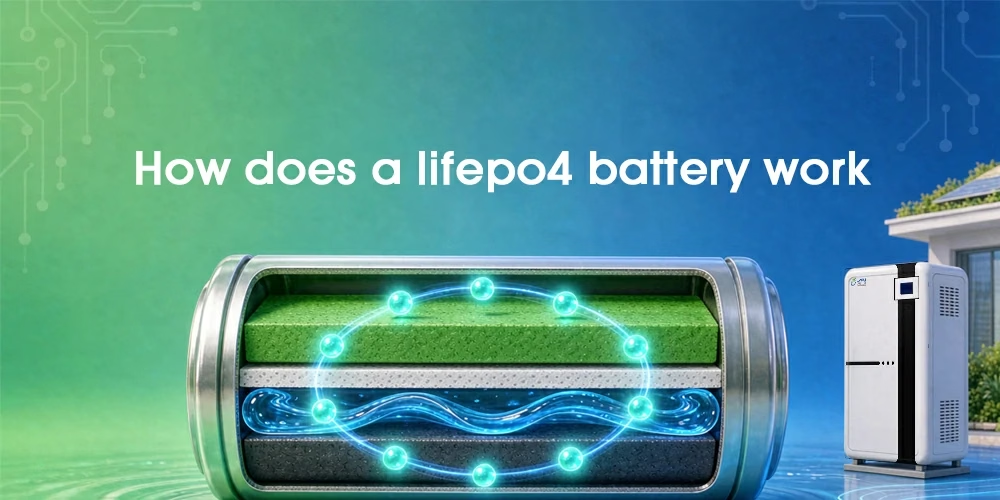
Four Parts Inside the Box
A lithium cell contains four components, and each one has a single, clear job.
- | Cathode (positive electrode) | Lithium iron phosphate (LiFePO4) | The side that releases lithium ions |
- | Anode (negative electrode) | Graphite (a carbon material) | The side that receives and hosts lithium ions |
- | Electrolyte | Lithium salt + organic solvent | The “track” the ions travel along |
- | Separator | Microporous polymer film | Lets ions pass through, blocks electrons — no internal short circuit |
Two of these deserve a second look. First, the electrolyte is literally the road: without it, ions have nowhere to run. Second, the separator is the quiet safety hero. It is a thin film full of microscopic holes — small enough to let ions squeeze through, yet tight enough to keep electrons out. Because electrons cannot cross it, the battery cannot short-circuit itself from the inside.
How Charging and Discharging Actually Work
The whole process is lithium ions swinging back and forth between the two electrodes — which is why engineers nicknamed it the rocking-chair battery.
Charging: Lithium ions leave the cathode → travel through the electrolyte and across the separator → embed into the graphite layers of the anode. Meanwhile, electrons flow from the positive terminal to the negative terminal through the external circuit — the charger pushes them there.
Discharging: Lithium ions leave the anode → travel back through the electrolyte and separator → re-insert into the cathode. At the same time, electrons flow from the negative terminal to the positive terminal through your external circuit, and that electron flow powers your load.
Put it in one line: a battery is not a “bucket of stored electricity” — it is a container where lithium ions keep moving home and back. The more ions that move, the bigger the capacity; the faster they move, the higher the power.
The Six Numbers on Every LFP Spec Sheet
- | Nominal voltage | V | 3.2V per cell | LFP is a 3.2V chemistry — not 3.7V, which belongs to NMC |
- | Charge cutoff voltage | V | 3.65V per cell | The BMS stops charging here; overcharging damages the cell |
- | Discharge cutoff voltage | V | 2.5V per cell | Stop at 2.5V; do not force the cell to drain lower |
- | Capacity | Ah | 50Ah / 100Ah / 200Ah / 280Ah / 314Ah are common | Ah × V = Wh — only then is it real energy |
- | SOC / DOD | % | Daily DOD ≤ 90% recommended | The 10% headroom buys extra life |
- | Cycle life | cycles | ≥ 6,000 cycles (at 80% DOD) | Roughly 16 years of one charge per day, fading to 80% capacity |
Voltage: Why 3.2V, Not 3.7V
If you have read spec sheets from phones or power tools, you may remember 3.7V as “the” lithium voltage. That figure belongs to NMC (ternary) cells, however. LFP chemistry settles at a nominal 3.2V — its discharge curve sits on a famously flat plateau near that point.
This matters in practice, because it decides how cells get counted in series. Sixteen LFP cells in series deliver 16 × 3.2V = 51.2V, which is exactly the “51.2V” label you see on the 280Ah packs we discussed in the air-conditioner runtime article. Meanwhile, the cutoffs bracket every cycle: the BMS stops charging at 3.65V and stops discharging at 2.5V. Both limits exist for the same reason — pushing past them damages the cell, so the BMS enforces them automatically.
Capacity: Ah × V = Wh
Amp-hours measure how much charge the cell can shuttle, but charge alone is not energy — you need the voltage too. That is why Ah × V = Wh is the most useful multiplication in this whole article.
Run it on a real example: a 51.2V, 280Ah pack carries 51.2 × 280 = 14.3kWh of nominal energy. Consequently, when a salesperson quotes you “280Ah,” always ask what voltage it multiplies by — because 280Ah at 12V and 280Ah at 51.2V describe systems that differ by more than four times in stored energy.
DOD and Cycle Life: The 10% That Doubles the Years
Depth of discharge (DOD) is simply how much of the battery you use before recharging. Cycling to 100% every time stresses the cell hard; stopping at 90% or less leaves a 10% headroom that roughly doubles the achievable cycle life.
Now put the numbers together. An LFP cell is rated for ≥6,000 cycles at 80% DOD. If you cycle once a day, 6,000 ÷ 365 ≈ 16 years before the battery fades to 80% of its factory capacity. Naturally, real-world results vary with temperature, charging speed, and resting SOC — but the order of magnitude explains why LFP dominates stationary storage.
Summary: A Moving Van, Not a Bucket
Four parts, one mechanism. Cathode releases ions, anode hosts them, the electrolyte is the road, and the separator keeps electrons from taking a shortcut.
Voltage brackets the ride. 3.2V nominal, 3.65V charge cutoff, 2.5V discharge cutoff — and the BMS enforces all of it.
Energy is a calculation, not a label. Ah × V = Wh; DOD ≤ 90% daily; ≥6,000 cycles ≈ 16 years at one charge per day.
A battery does not “hold” electricity the way a bucket holds water. It is a container where lithium ions keep shuttling — and every spec sheet you read is just a description of how many ions can move, how fast, and for how many years.
Frequently Asked Questions
What are the four main parts of a lithium battery?
The cathode (LiFePO4 in LFP cells, which releases lithium ions), the anode (graphite, which hosts them), the electrolyte (the ion track), and the separator (a microporous film that lets ions pass but blocks electrons).
Why is the nominal voltage 3.2V instead of 3.7V?
3.7V is the nominal voltage of NMC (ternary) cells. LFP chemistry has a flatter discharge plateau and settles at 3.2V nominal per cell.
What does Ah on a battery label mean?
Amp-hours measure the amount of electric charge the battery can deliver. It describes capacity, but not energy by itself.
How do I convert Ah to kWh?
Multiply Ah by the pack voltage to get Wh, then divide by 1,000. For example, 51.2V × 280Ah = 14,336Wh ≈ 14.3kWh.
What DOD should I use every day?
Keep daily depth of discharge at or below 90%. The remaining 10% headroom roughly doubles the achievable cycle life compared with full 0–100% cycling.
How long will a 6,000-cycle LFP battery last?
At one full-equivalent cycle per day, about 16 years before capacity fades to 80% of the factory value — assuming moderate temperatures and reasonable charge rates.
