

Project Overview
As more homeowners explore solar energy to manage household electricity consumption, residential energy storage provides a practical way to store electricity for use when solar generation decreases.
In this residential solar energy storage project in the Philippines, LVFU supplied a 51.2V 314Ah floor-standing lithium battery to work with the homeowner’s existing Solis inverter and rooftop solar panels. The installation demonstrates how a compatible lithium battery can integrate into a residential solar energy system without requiring the homeowner to replace their existing inverter.
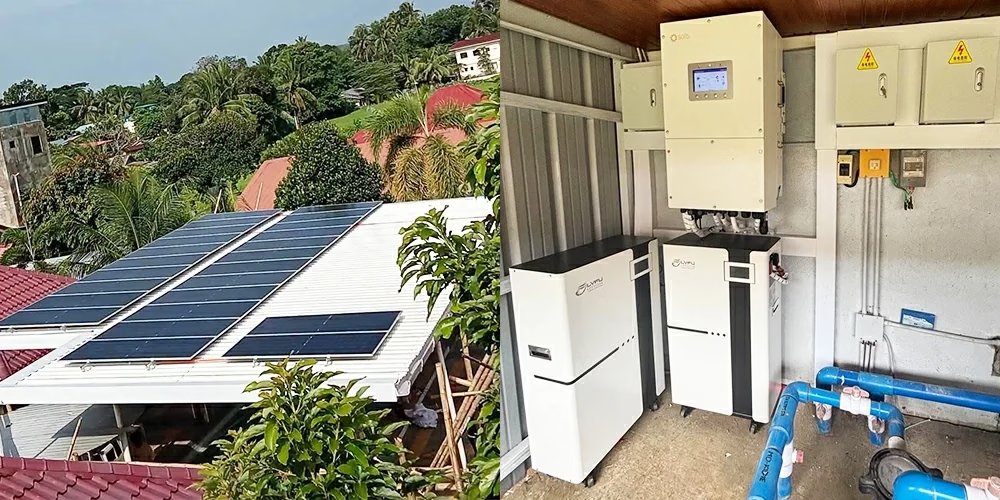
Project highlights
- Location: Philippines
- Application: Residential solar energy storage
- Battery supplier: LVFU
- Battery type: Floor-standing lithium battery
- Battery specifications: 51.2V, 314Ah
- Nominal energy capacity: Approximately 16.08 kWh
- Inverter: Customer-owned Solis inverter
- Solar generation: Customer’s rooftop solar panels
System Configuration: Solar Panels, Solis Inverter, and LVFU Battery
The homeowner already had rooftop solar panels and a Solis inverter. LVFU supplied the floor-standing lithium battery to complete the energy storage configuration.
The system combines three key components:
1. Rooftop Solar Panels
The rooftop solar panels generate electricity from sunlight to support household energy consumption. When solar production exceeds immediate demand, the system may direct surplus electricity to the battery, depending on the inverter configuration and system settings.
2. Solis Inverter
The homeowner uses a Solis inverter to manage power conversion and coordinate the solar and battery system. The LVFU battery works with the customer’s inverter through a compatible configuration, subject to the supported battery communication protocol and installation settings.
3. LVFU 51.2V 314Ah Floor-Standing Lithium Battery
LVFU provided a floor-standing lithium battery with a nominal voltage of 51.2V and a capacity of 314Ah. These specifications correspond to approximately 16.08 kWh of nominal energy storage.
The battery stores energy for later use, allowing the household to make better use of available solar generation. Actual usable capacity depends on the battery’s operating limits, configuration, and system settings.
How the Residential Solar Energy Storage System Works
A residential solar energy storage system can help homeowners use solar power more flexibly throughout the day.
During daylight hours, the rooftop solar panels generate electricity. The system first supplies household loads according to its configuration. When solar generation exceeds the home’s immediate electricity demand, the inverter can direct available surplus energy to charge the battery.
Later, when solar production decreases, the battery can supply stored energy to compatible household loads through the inverter. This arrangement can increase solar self-consumption and reduce reliance on grid electricity when operating conditions allow.
The system’s actual performance depends on solar panel output, household electricity demand, battery charge levels, inverter settings, and local grid conditions. Backup power during a grid outage also depends on whether the inverter supports backup operation and whether the installer has configured the system accordingly.
Why Choose an LVFU 51.2V 314Ah Floor-Standing Battery?
1. High-Capacity Energy Storage
With a nominal capacity of approximately 16.08 kWh, the LVFU 51.2V 314Ah battery provides substantial storage for residential solar applications. Its capacity allows homeowners to store more solar energy for use when generation falls, although actual coverage depends on household consumption and available stored energy.
2. Integration with an Existing Inverter
Homeowners do not always need to replace an existing inverter when adding battery storage. In this project, LVFU supplied a battery compatible with the customer’s Solis inverter configuration.
Before installation, system designers should verify battery voltage requirements, communication protocols, charge and discharge limits, firmware compatibility, and the inverter manufacturer’s approved battery settings. These checks help ensure reliable system operation.
3. A Practical Floor-Standing Design
The floor-standing battery format provides a dedicated enclosure for residential energy storage equipment. Installers should select a suitable location with adequate clearance, ventilation where required, appropriate environmental conditions, and safe access for inspection and maintenance.
4. Flexible Use of Rooftop Solar Energy
By combining rooftop solar panels, a compatible inverter, and battery storage, the homeowner can store some of the electricity generated during sunny periods for later use. This setup can improve solar self-consumption and provide greater flexibility in household energy management.
LVFU Residential Energy Storage Solutions
This Philippine installation illustrates LVFU’s approach to residential energy storage: supplying a suitable lithium battery that integrates with the customer’s existing solar equipment.
LVFU provides lithium battery solutions for residential and commercial energy storage applications. For homeowners, solar installers, distributors, and system integrators, choosing the right battery involves more than comparing capacity. Voltage compatibility, inverter communication, charge and discharge requirements, installation conditions, and future energy needs all matter.
If you are planning a residential solar energy storage project in the Philippines or another market, LVFU can help you evaluate battery capacity and system compatibility for your application.
