

Across Southeast Asia, temperatures stay high all year, so cooling equipment such as air conditioners drives an extremely heavy power demand. On top of that, several areas suffer from grid fluctuations. As a result, a Battery Energy Storage System (BESS) has become a vital choice for both residential and commercial users who want stable power and lower electricity bills.
However, most buyers hit the same question early: do you need a single-phase or a three-phase energy storage system?
Before you decide, learn how the two supply types differ and where each one fits. This guide walks you through the fundamentals, the three differences that actually change your decision, and a simple rule for choosing.
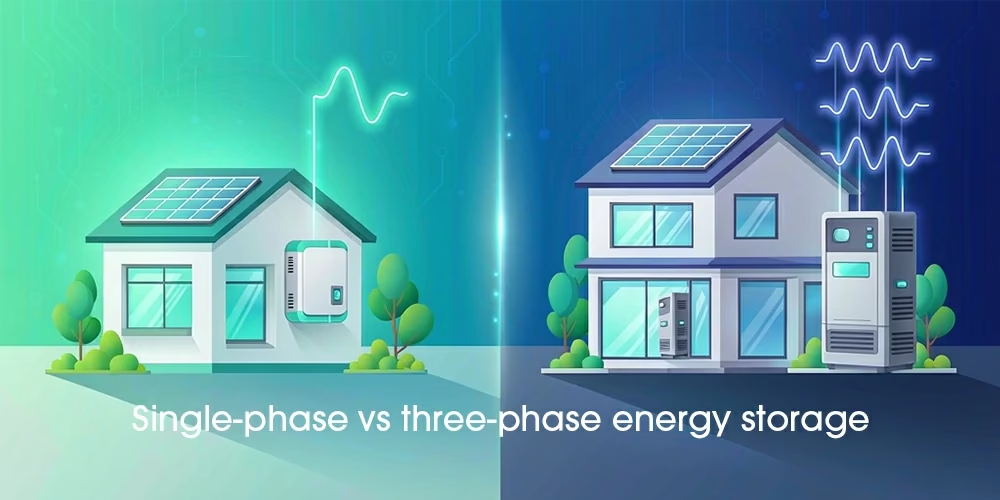
Key Takeaways
- Your meter type decides first. A single-phase meter takes a single-phase ESS; a three-phase meter takes a three-phase ESS.
- Single-phase runs 220–230 V, suits apartments and small-to-medium homes, and typically covers 3 kW–6 kW of storage power.
- Three-phase runs 380–400 V line voltage, starts around 10 kW, and balances loads across all three phases.
- Never connect a single-phase ESS to a three-phase meter without a technical review — you risk overloading one phase and creating voltage instability (“phase imbalance”).
- Three-phase supports future expansion — more air conditioners, heat pumps, and EV chargers — and handles grid feed-in far better in high-load markets.
1. Start With the Basics: How the Two Supply Types Differ
Power systems divide into single-phase and three-phase, and understanding that split is the first step toward choosing the right BESS.
1) Single-phase power
- How it works: One live wire (phase) plus one neutral wire carries the supply, and the voltage typically runs at 220 V–230 V — the common standard across Southeast Asia.
- What it suits: Its simple structure fits ordinary residences and small shops. Moreover, most household appliances — lighting, TVs, refrigerators, and standard air conditioners — already run on single-phase power.
- What it means for storage: A single-phase energy storage system usually carries a lower power rating, typically 3 kW–6 kW, and it connects directly to the home’s existing single-phase distribution box. Therefore, it serves daily electricity use and basic backup power in an ordinary household very well.
2) Three-phase power
- How it works: Three live wires, spaced 120 degrees apart, plus one neutral wire carry the supply, and the line voltage typically runs at 380 V–400 V.
- What it suits: It delivers high output power and stable operation, so it drives high-power equipment — central air conditioners, heat pumps, large motors, and fast chargers.
- What it means for storage: A three-phase energy storage system carries a higher power rating, typically 10 kW and above, and it achieves true three-phase load balancing. Consequently, it fits large villas, commercial and industrial sites, and any household running high-power appliances.
2. Where the Choice Really Bites: Three Core Differences
Once you understand the basics, three practical differences decide which system you should buy.
1) Load capacity and phase balancing
If you connect a single-phase ESS to a three-phase meter, you can easily overload one phase, and that produces voltage instability — the problem installers call phase imbalance. Therefore, pair a single-phase ESS with a single-phase meter.
A three-phase ESS, on the other hand, automatically adjusts its output across the three phases and balances the loads of a home or a factory perfectly. In doing so, it keeps high-power equipment such as central air conditioners running smoothly. In short, it is the optimal solution for any three-phase grid user.
2) Meter and equipment compatibility
Your meter sets the boundary:
- Single-phase meter → you can only choose a single-phase energy storage system.
- Three-phase meter → you can choose a three-phase ESS, which is the best match. Under specific technical conditions you may also run a single-phase ESS, but you must then watch load balancing closely.
Common three-phase-meter sites include new villas, large homes, and commercial or industrial premises. For all of them, we generally recommend choosing a three-phase system first, because it maximizes efficiency.
3) Grid connection and future expansion
In Southeast Asia, electricity loads stay consistently high. Because of that, a single-phase system can hit limits when it connects to the grid or discharges energy: the single-phase grid’s capacity may restrict reverse power flow or even trip the system.
A three-phase system avoids that ceiling. It offers larger capacity, so it covers your self-consumption needs while supporting grid feed-in much better. In addition, it leaves room for future equipment — for example, adding more high-power air conditioners or EV chargers later on.
3. Quick Decision Table
| Your situation | Choose | Why |
| Apartment or small-to-medium home, single-phase meter, standard appliances | Single-phase ESS | Covers night-time demand and basic backup at the best cost-effectiveness |
| Large villa with central AC, heat pump, or three-phase EV charger | Three-phase ESS | Delivers the power those loads need and keeps them stable |
| Commercial or industrial site with a three-phase meter | Three-phase ESS | Balances all three phases and supports high-power equipment |
| You plan to add more AC units or EV chargers soon | Three-phase ESS | Leaves capacity for expansion and grid feed-in |
| You only need essential backup for lights, fridge, and fans | Single-phase ESS | Simple, lower-cost, and sufficient for the load |
4. So, Which System Do You Need?
The answer depends on two things: your meter type and your load requirements.
Choose a single-phase ESS if: you live in an ordinary apartment or a small-to-medium residence, standard appliances dominate your load, you run a single-phase meter, and your main goal is to cover night-time electricity demand plus basic backup power. In that case, a single-phase system gives you the best cost-effectiveness.
Choose a three-phase ESS if: you live in a large villa, you run central air conditioning, heat pumps, or three-phase EV chargers, or your business draws commercial and industrial power through a three-phase meter. Here, make sure you specify a three-phase energy storage system — it provides far more robust power support and keeps high-power equipment stable around the clock.
Above all, remember the market you are buying into. In a region that stays hot all year, choosing the right system is what maximizes the value of every kilowatt-hour.
5. FAQ: Choosing Between Single-Phase and Three-Phase Storage
Can I connect a single-phase ESS to a three-phase meter?
Technically it is possible under specific conditions, but we do not recommend it as a default. You risk overloading a single phase, which causes voltage instability or phase imbalance. Have an installer review the load distribution first.
Do I need a three-phase ESS for central air conditioning?
Yes, in most cases. Central AC, heat pumps, and large motors need the higher output and the phase balancing that only a three-phase system (typically 10 kW and above) delivers reliably.
What is phase imbalance, and why does it matter?
Phase imbalance happens when one phase carries much more load than the others, so voltage becomes unstable. It stresses equipment, trips protection, and shortens appliance life — which is exactly why a single-phase ESS belongs on a single-phase meter.
Which system suits an apartment versus a villa?
An apartment or small-to-medium home with a single-phase meter suits a single-phase ESS. A large villa with a three-phase meter, central AC, or an EV charger suits a three-phase ESS.
Can I start with single-phase and expand later?
You can, but expansion is limited by the single-phase grid’s capacity. If you plan to add high-power air conditioners or EV chargers, choose three-phase from the start to avoid reverse-power restrictions and tripping.
Is a three-phase ESS worth it for an ordinary home?
It is worth it when your home already has a three-phase meter or high-power appliances. For a standard home dominated by lighting, TV, refrigerator, and standard AC, a single-phase ESS usually delivers better cost-effectiveness.
6. Conclusion: Match the System to Your Meter and Your Loads
Choosing between a single-phase and a three-phase BESS comes down to three checks: read your meter, list your high-power loads, and plan the equipment you will add next.
Therefore, start with the meter. If it is single-phase, a single-phase ESS will serve your night-time demand and backup needs at the lowest cost. If it is three-phase — or if central air conditioning, heat pumps, three-phase EV chargers, or commercial loads are in the picture — specify a three-phase system, and you will get the balancing, the expansion room, and the grid feed-in performance your site needs.
In a market as hot and as load-hungry as Southeast Asia, that single decision determines how much value you extract from every stored kilowatt-hour.
Note: Voltage levels, power ratings, and grid-connection rules vary by country and utility. Always confirm your meter type, available supply capacity, and local feed-in rules with a qualified installer before you buy.
