

In solar energy storage systems, two connection methods exist: DC coupling and AC coupling. The core difference between them lies in the path that solar energy takes to reach the battery.
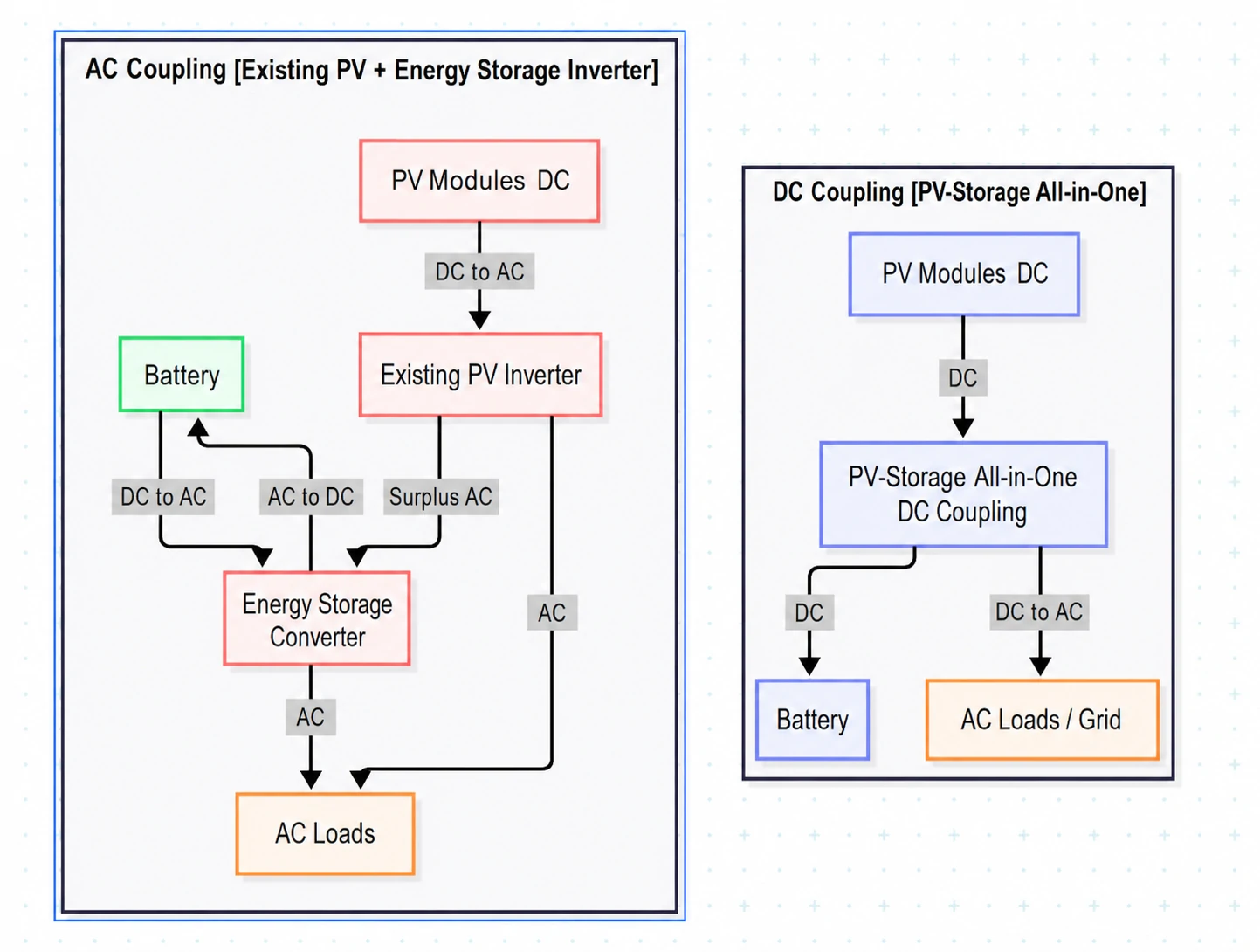
To put it simply, AC coupling means that solar power passes through the PV inverter to become AC power, and then goes through the energy storage system’s PCS to convert back to DC power before entering the battery. DC coupling, on the other hand, means that solar power goes directly through the MPPT and enters the battery without any additional conversion.
Below are the circuit diagrams for both AC coupling and DC coupling.
Comparison Overview: Six Key Dimensions
To help you decide which approach fits your project best, we compare the two technologies across six critical dimensions.
1. Efficiency
DC coupling achieves higher efficiency, typically ranging from 87% to 92%. Because the system performs only one DC-to-AC conversion, energy loss remains minimal.
AC coupling, in contrast, delivers lower efficiency, usually between 80% and 85%. The system goes through two bidirectional DC-to-AC conversions, with each conversion losing about 2% to 3% of energy. As a result, AC coupling wastes more power over time.
2. Cost
For new installations, DC coupling costs less. The system requires only one device – a hybrid inverter – which saves on initial investment.
AC coupling, however, requires two separate devices: a standalone PV inverter and a battery energy storage inverter. This means higher upfront costs. Therefore, for budget-sensitive projects, DC coupling offers a clear advantage.
3. Application Scenarios
DC coupling suits new projects and off-grid systems. Since you design the system from scratch, you can fully leverage its high efficiency and lower cost.
AC coupling, by contrast, excels in retrofit projects and grid-interactive systems. It works perfectly for sites that already have a functioning PV system, allowing you to add storage without starting over.
4. Flexibility
DC coupling offers limited flexibility. Because the PV and storage are tightly integrated, expanding or modifying the system presents more restrictions.
AC coupling, however, provides exceptional flexibility. Each subsystem operates relatively independently. This allows you to expand capacity as needed and even build the system in phases.
5. Redundancy and Reliability
DC coupling concentrates risk. If the critical “PV-plus-storage” hybrid inverter fails, the entire solar-plus-storage system may shut down.
AC coupling, in contrast, offers strong redundancy. Even if the storage inverter fails, the PV system can usually continue working. This enhances overall system reliability.
6. Backup Power Capability
DC coupling delivers stronger backup performance. During a grid outage, the system can draw directly from the battery with fast switching. This makes it better suited for applications that require high power reliability.
AC coupling shows weaker backup capability. The system’s response mechanism during outages is more complex. Some older designs may not even allow the battery to supply backup power during a blackout. Hence, you should carefully verify this feature for AC-coupled systems.
Choosing the Right Solution for Your Project
After comparing these six dimensions, how do you make the final decision? Here is our practical guidance.
Choose DC coupling if:
- The client has a tight budget, and
- The project is on a new site (no existing PV inverter), and
- The plan includes a diesel generator for off-grid operation without utility power.
Under these conditions, DC coupling is the better choice. Its lower upfront cost, higher system integration, and faster backup response make it ideal for off-grid scenarios where reliable power supply matters most.
Choose AC coupling if:
The client already has an established PV system and wants to add storage.
In this case, AC coupling is the superior option. You do not need to replace the existing inverter. The retrofit takes less time, maintains compatibility, and preserves the original system’s power generation revenue.
Final Thoughts: Beyond Simple Trade-Offs
In conclusion, DC coupling and AC coupling are not about one being inherently better than the other. Instead, you should weigh them systematically based on project stage, grid conditions, reliability requirements, and long-term evolution goals.
DC coupling involves relatively simple control logic, but it places high demands on the PCS’s MPPT accuracy and battery management coordination.
AC coupling, on the other hand, requires more complex control strategies. The system must coordinate the PV inverter, PCS, and grid dispatch instructions. However, this complexity brings greater scheduling flexibility and remote operation capabilities. It supports advanced functions such as PV-storage collaborative peak shaving, demand response, and virtual power plant integration.
Finally, keep in mind that AC coupling does incur additional conversion losses. Plan your system capacity accordingly to account for this extra energy loss.
🎨 Contact Lvfuenergy to Get Free Energy Storage Solutions
