

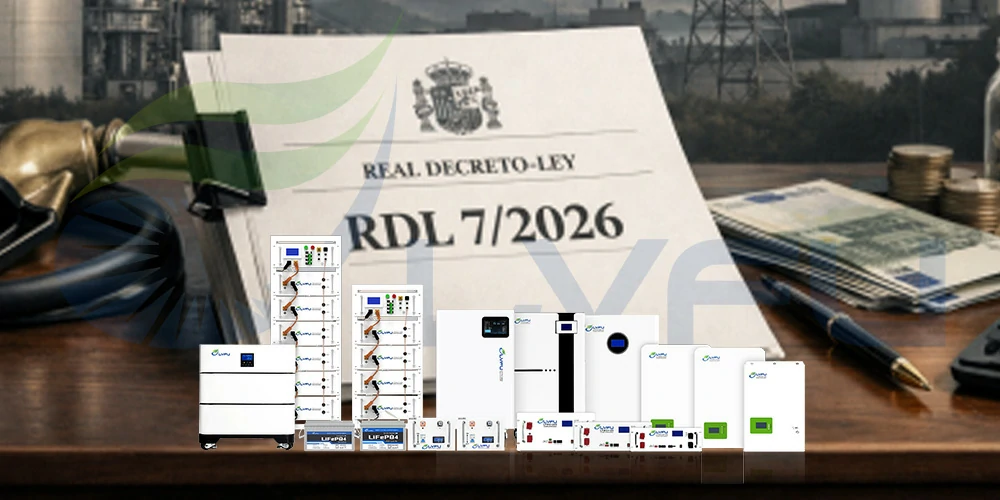
The core of Spain’s recently passed Real Decreto-ley 7/2026 policy lies in “acceleration” and “market flexibility.”
Seizing the Opportunity of “Acceleration Zones” (ZARs)
Policy: Various autonomous communities in Spain are establishing “Renewable Acceleration Zones,” which significantly simplify project approvals.
LVFU Response: Prioritize finding installers (EPCs) with projects in these zones. Due to the fast approval process, they have extremely high requirements for battery availability and delivery speed. If you have a warehouse in Spain that can provide rapid local delivery, it will be a huge competitive advantage.
Addressing the Pain Point of “Negative Electricity Prices”
Current Situation: Negative electricity prices will frequently occur in the Spanish electricity market in 2026 (especially at midday).
LVFU Response: Sales pitches should shift from “saving money” to “profitability.” Educate customers to use energy storage systems to charge during negative electricity prices and discharge during peak hours. LVFU batteries need to emphasize their EMS (Energy Management System) compatibility to ensure compatibility with Spain’s dynamic electricity pricing API.
Capacity Reservation Charge
Policy: New regulations levy a capacity reservation charge on facilities with grid connection voltage ≥1 kV, aiming to combat projects that “occupy space but don’t build.”
LVFU Response: Industrial customers (C&I) now prefer “compact, high-efficiency” solutions to reduce the complexity of grid connection applications. Promote LVFU’s all-in-one commercial and industrial energy storage units, emphasizing their “plug-and-play” nature and minimal grid impact.
