

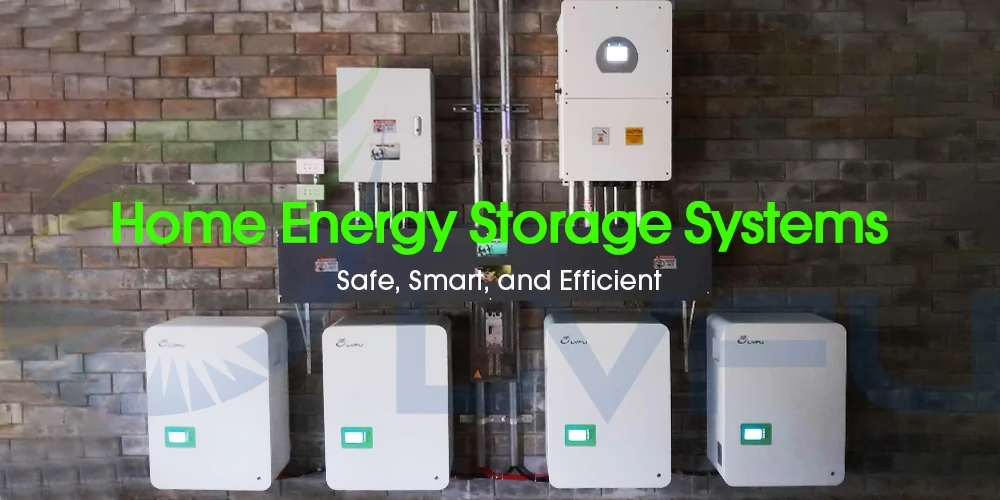
These days, our homes rely on electricity for just about everything. But what happens when the power goes out or the grid gets shaky? More and more homeowners are finding their answer in a home energy storage system—a personal power bank for your house.
1. How It Actually Works in Your Home
Imagine a large-scale version of the battery in your phone, but for your entire home. Its main purpose is straightforward—to keep essential things running during a power cut. But what many people find really valuable is the day-to-day benefit. In lots of places, electricity costs less late at night. A home battery lets you charge up during those off-peak hours, then run your home on that stored, cheaper power during the expensive late afternoon and evening times. It’s a simple shift that starts saving you money from day one.
2. Breaking Down the Tech (In Simple Terms)
What’s inside the box? Let’s keep it simple.
- The Battery Pack: This is the storage tank, typically using the same robust lithium-ion technology found in electric cars.
- The Inverter: Think of this as a translator. It takes the battery’s direct current (DC) and converts it into the alternating current (AC) that every plug in your house needs.
- The Brain: A smart controller manages the whole show. It decides the best times to charge from the grid (or your solar panels) and when to power your home, all based on your habits and local rates.
- The Safety Net: Multiple protection systems are built in, constantly monitoring for anything unusual and shutting down safely if needed—it’s built to be worry-free.
So, what’s in it for you?
- Reliability You Can Count On: It’s about security. When storms hit or the grid has issues, your home stays on, automatically and quietly.
- Smarter Energy, Automatically: The system handles the complexity. It learns and adapts, optimizing for savings without requiring you to micromanage it.
- Direct Savings on Your Bill: This is the clear financial win. By using your own stored power during high-rate periods, you actively avoid the most costly electricity.
- A Step Toward Energy Independence: If you have solar panels, a battery is the missing link. It lets you use your own sun-powered energy at night, greatly reducing your reliance on the utility company.
3. More Than an Emergency Backup: Everyday Value
While peace of mind during outages is a huge benefit, families use these systems every single day:
- No More Interruptions: Say goodbye to resetting clocks or losing work during a brief blackout. Life simply continues.
- Outsmarting Your Utility Rate: You’re no longer at the mercy of peak pricing. The battery delivers your own pre-purchased, low-cost power when rates spike.
- Essential Preparedness: For those in areas with extreme weather or fire risks, it provides a critical layer of self-reliance.
- Maximizing Solar Investment: For solar homeowners, a battery captures excess energy that would otherwise be sent back to the grid, allowing you to use more of what you produce.
I spoke with a family down in Florida who put this to the test. After installing a system, they were surprised to see their electric bill drop by about 40% just by avoiding peak charges. Then a hurricane knocked out power for a day and a half. While their neighbors were dealing with generators and spoiled food, their home—lights, internet, fridge—hummed along normally. “It wasn’t just convenient,” the homeowner told me, “it was a total game-changer for our sense of security.”
4. Where This Is All Heading
Let’s be honest, the initial cost is still a consideration for many. But the conversation is shifting from “Is it worth it?” to “When is the right time?”. The technology is getting better and cheaper each year, and the long-term value—both in dollars saved and in reliability gained—is becoming undeniable. What was once a niche product for enthusiasts is quickly becoming a standard feature for a modern, efficient, and resilient home. It’s less about a futuristic gadget and more about taking a practical, smart step forward in how we power our daily lives.
