

Commercial and industrial (C&I) energy storage is playing an increasingly important role in modern energy systems. As businesses actively search for ways to reduce electricity costs, stabilize power supply, and integrate renewable energy, C&I energy storage has become a practical and widely adopted solution. Below is a clear overview of its key application scenarios and system types.
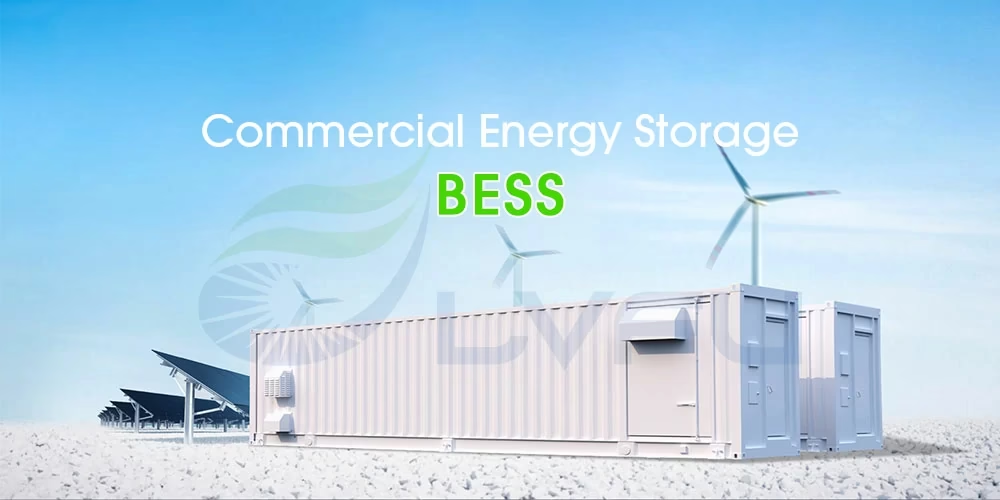
Energy Storage Scenarios
First, let’s break down energy storage by where it’s used: generation-side, grid-side, and user-side.
Typically, the term pre-meter or large-scale storage refers to systems on the generation and grid sides.
Conversely, post-meter storage refers specifically to the user side, which we then split into commercial & industrial and residential categories, depending entirely on the end customer.
Four Major Application Scenarios for Industrial and Commercial Energy Storage
Factories and Shopping Malls
Indeed, factories and shopping malls exhibit distinct electricity consumption patterns. By installing energy storage systems, they can actively shift consumption from peak to off-peak hours, manage maximum demand, and significantly reduce overall electricity costs. Additionally, these systems serve as reliable backup power during emergencies.
Photovoltaic-Storage Charging Stations
Similarly, photovoltaic-storage charging stations demonstrate another key application. These stations primarily use solar power to meet their own electricity needs and supply clean energy to electric vehicle charging points. Meanwhile, the integrated energy storage component effectively helps buffer the grid from the impact of high-power charging, ensuring more stable operation.
Microgrids
Furthermore, microgrids represent a crucial area for energy storage deployment. Microgrids provide the flexibility to operate either connected to or independently from the main grid. Common setups include industrial park microgrids, island microgrids, and microgrids in remote areas. Within these systems, energy storage consistently plays a key role in balancing local power generation with electricity demand.
Emerging Application Scenarios
Beyond these established uses, industrial and commercial energy storage is actively exploring new integrated development scenarios. In fact, these systems have already been deployed in numerous innovative applications such as data centers, 5G base stations, battery-swapping trucks, and port shore power.
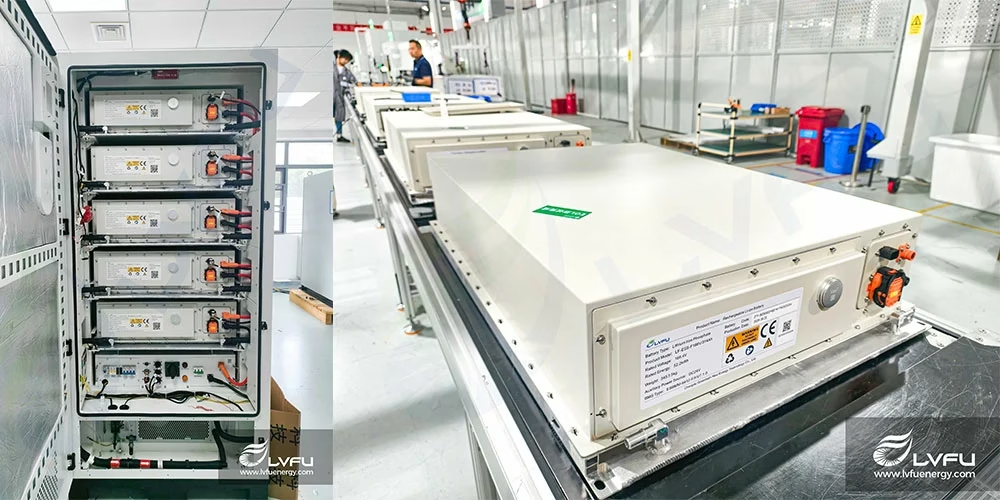
We can broadly classify commercial and industrial energy storage into two main types: systems paired with photovoltaics and those that operate independently.
This categorization depends entirely on whether the storage is installed alongside an existing commercial or industrial solar power generation system.
Photovoltaic-supported commercial and industrial energy storage
For commercial and large industrial users, installing a combined photovoltaic and energy storage system enables them to generate and consume their own electricity, smooth out solar power generation fluctuations, and increase the utilization of clean energy. At the same time, the energy storage component can also be used independently for peak-valley arbitrage.
Non-photovoltaic-supported commercial and industrial energy storage
On the other hand, for sites like commercial buildings, schools, and hospitals where large-scale rooftop solar isn’t feasible, installing a standalone energy storage system still offers significant benefits. These systems allow facilities to smooth peak loads, fill demand valleys, and capitalize on peak-valley electricity price differences effectively.
