

Part I – LVFU ESS 125KW/261KWH System Design and Core Capabilities
LVFU ESS Battery 125kW/261kWh provides a comprehensive energy storage solution for industrial and commercial applications. The system combines two main components: a battery cabinet and an electrical cabinet. This modular design allows users to rapidly expand both power and capacity, effectively meeting diverse customization needs.
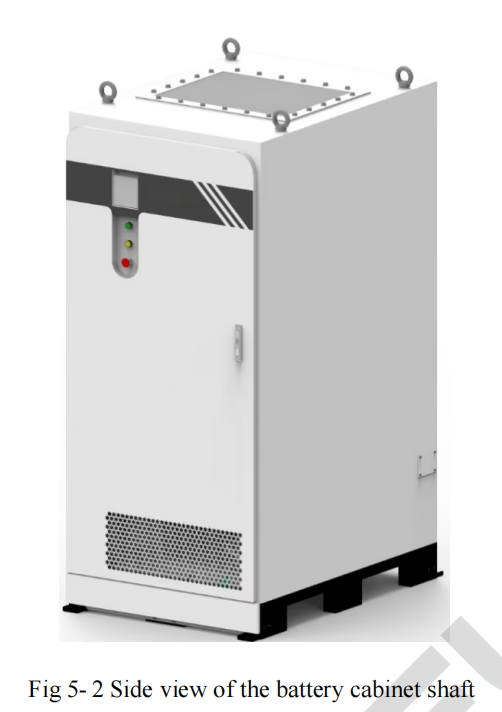
Within the battery cabinet, you will find a 261kWh energy storage battery, complete with integrated fire protection systems, liquid cooling systems, high-voltage boxes, and other essential equipment. Meanwhile, the electrical cabinet offers a variety of configuration schemes, which customers can customize according to specific requirements. It also supports multiple integrated functions, including PCS, EMS, MPPT, and STS.
Additionally, the entire cabinet system achieves an IP55 protection level, ensuring adaptability to various application environments. Meanwhile, the liquid cooling system within the cabinet performs effective thermal management of the battery system. To accommodate different capacity requirements, the LVFU ESS Battery can flexibly scale capacity on both the AC and DC sides. For example, up to four battery cabinets can operate in parallel with a single 400V electrical cabinet, significantly extending the system’s duration from the default 2 hours to a maximum of 8 hours.
Part II – LVFU ESS BATTERY Technical Specifications and Scaling Potential
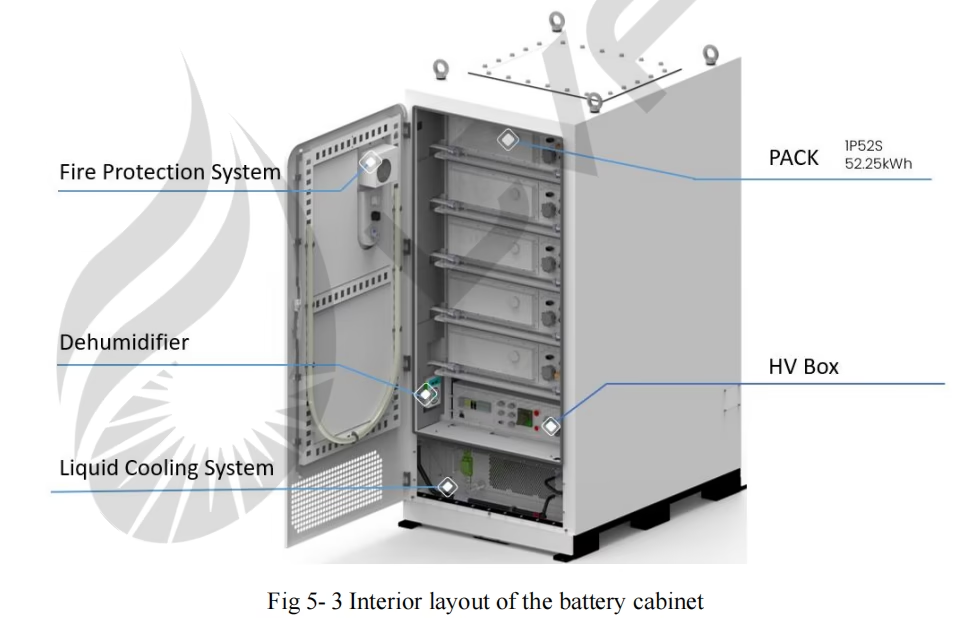
Looking inside the system, we find that five liquid-cooled battery packs and one high-voltage box together form the 261kWh battery cluster. Each pack integrates 52 high-performance lithium iron phosphate cells, all arranged in series, with each cell rated at 314Ah and supporting 0.5P charge and discharge rates. Correspondingly, the high-voltage box houses the battery cluster management unit along with protection and control components, enabling it to monitor and safeguard the entire cluster’s operation effectively. For system management, a single cabinet utilizes a master-slave two-tier battery management architecture (BMU-BCU). However, when users connect two or more cabinets in parallel, the system shifts to a three-level management structure (BMU-BCU-Samkoon), delivering comprehensive battery protection that covers cell protection, over-current and over-voltage prevention, temperature control, energy storage converter voltage safety, and grid-connection safeguards, among other functions.
Regarding physical specifications, the battery cabinet measures W1000D1383H2189mm and weighs approximately 2376kg. Similarly, the electrical cabinet dimensions are W846D1368H2205mm, with a weight of around 769kg. Finally, for a deeper understanding of the system, we will explore key components such as the fire protection system and cooling system in our next discussion.
