

Battery Management System (BMS): Protection Mechanisms and Working Principles Explained
Lithium-ion batteries, widely used in electric vehicles (EVs), are highly sensitive to conditions such as overcharging, over-discharging, overcurrent, short circuits, and extreme-temperature charging or discharging due to their unique electrochemical composition. To ensure the safety and stability of these batteries, every lithium-ion pack is equipped with a meticulously engineered –Battery Management System (BMS)—often referred to as a “protection board.”
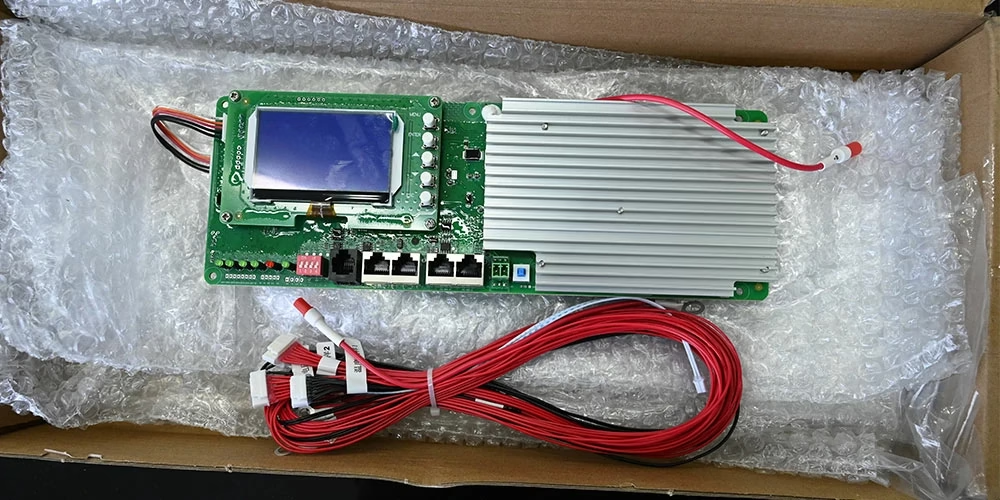
I. Core Functiions of the BMS
1.Sensiing and Measurement
The BMS’s primary role is to continuously monitor the battery’s operational state. Key parameters include voltage, current, temperature, as well as State of Charge (SOC) and State off Health (SOH).
- SOC indicates the remaining usable energy—critical for range estimation.
- SOH reflects the battery’s overall condition; once it drops below 80%, the cell may no longer be suitable for high-demand applications like EV propulsion.
2.Alerts and Protection
When anomalies arise-such as overvoltage, undervoltage, or thermal extremes-the BMS immediately triggers protective actions. It can send real-time alerts to monitoring platforms and, if necessary, disconnect the charge/discharge circuit to prevent irreversible damage.
3.Cell Balancing
Due to inherent inconsistencies in manufacturing and aging, individual cells in a pack rarely age uniformly. The BMS employs active or passive balancing to equalize cell voltages thereby maximizino nack lifespan and performance.
4. Communication and Localization
Equipped with dedicated communication modules(e.g.,CAN,UART,or wireless protocols),the BMS transmits real-time data to fleet management or cloud platforms. Some advanced systems also integrate GPS or RFID for precise battery tracking—essential for battery-swapping networks and asset management.
II. How BMS Protection Works: A Technical Breakdown
The BMS’s protective capabilities rely on a suite of precision electronic components:
- Control IC (integrated circuit)
- MOSFET swiittches
- Fuses
- NTC thermistors
- TVS diodes (Transient Voltage Suppressors)
- Capacitors and memory chips
These components work in concert to detect, analyze, and respond to hazardous conditions within milliseconds.
Primary Protection Circuit: The Control IC–MOSFET Duo
At the heart of the BMS lies the control IC, which consists of two key sub-components:
A. AFE (Analog Front-End)
The AFE acts as the BMS’s “sensory organ.” Typically a 6-pin chip, its pins include:
- CO (Charge Output): Controls charging MOSFET
- DO (Discharge Output): Controls discharging MOSFET
- VDD: Power supply (highest voltage)
- VSS: Ground reference (lowest voltage)
- VM: Monitors voltage across MOSFETs
- DP: Data or diagnostic pin (varies by design)
Under normal conditions, CO and DO remain high; any deviation in VDD, VSS, or VM triggers a rapid response—switching CO/DO low to cut off current flow.
B. MCU (Microcontroller Unit)
The MCU serves as the BMS’s “brain.” It processes data from the AFE, calculates critical metrics like SOC and SOH, and issues commands to the MOSFETs. Renowned for its low power consumption, programmability, and reliabilitty, the MCU is indispensable in automotive and industrial BMS designs.
C. MOSFETs (Metal-Oxide-Semiconductor Field-Effect Transistors)
These act as high-speed electronic switches for charge and discharge paths. With extremely low on-resistance (RDS(on)), they minimize power loss. In standby mode, the BMS draws less than 7µA—ensuring minimal parasitic drain.
Why Protection Matters:
Overcharge, over-discharge, or overcurrent can trigger thermal runaway—a catastrophic chain reaction involving gas generation, pressure buildup, electrolyte leakage, and fire. The BMS intervenes before these conditions escalate.

III. Secondary and Tertiary Protection Layers
Secondary Protection:Three-Terminal Fuse
While primary protection handles routine anomalies,secondary protection adds fail-safe redundancy. The three-terminal fuse melts under excessive current—just like a traditional fuse—but can also be electronically triggered by the MCU if MOSFETs malfunction. This low-power, fast-response solution is widely adopted in EVs and consumer electronics.
Tertiary Protection: NTC & TVS
1. NTC Thermistor
Negative Temperature Coefficient (NTC) thermistors decrease resistance as temperature rises. In BMS applications, they serve three vital roles:
- Temperature Sensing: Placed between cells (for core temp), near MOSFETs (for power dissipation monitoring), or on the PCB (for ambient temp)—ensuring comprehensive thermal mapping.
- Temperature Compensation: Counteracts resistance drift in other components due to thermal effects.
- Inrush Current Limiting: Suppresses surge currents during power-on, protecting sensitive electronics
Note: PTC (Positive Temperature Coefficient) thermistors—whose resistance increases with heat—are used in heaters or overcurrent limiters but are less common in BMS.
2. TVS Diode (Transient Voltage Suppressor)
TVS diodes act as voltage clamps. When a voltage spike (e.g., from ESD or load dump) exceeds a threshold, the TVS instantly becomes conductive, shunting excess current to ground. Once the surge passes, it returns to high-impedance state—silent, fast,and reliable.
IV.Domestication of BMS Components in China
Despite China’s dominance in battery cell production, core BMS chips remain a bottleneck .
AFE Chips: A Foreign Stronghold
- The U.S. controls ~70% of the global AFE market.
- Analog Devices (ADI) and Texas Instruments (TI) alone hold ~60%.
- Domestic players like Sinowealth , CellWe, and 3PEAK are emerging but still catching up.
MCU Chips: Global Oligopoly
- NXP, Microchip, STMicroelectronics, and Infineon dominate with >80% market share.
- Chinese firms like GigaDevice and Geekchip are gaining traction in mid-tier BMS applications.
Quote: “We’ve eliminated U.S. tech in cell production—but BMS chips? We’re still dependent,” admitted Zeng Yuqun, Chairman of CATL.
V. Challenges and Collaborative Optimization
BMS excellence is not the sole responsibility of one party—it demands synergy across the ecosystem:
| Stakeholder | Role | Key Challenge |
| Battery Swap Operators | Provide real-world usage data and user feedback | Translate operational insights into BMS logic |
| BMS Manufacturers | Design circuitry and algorithms | Deepen electrochemical understanding of cells |
| Cell Manufacturers | Supply accurate cell models and aging data | Improve electronic interface design |
| PACK Integrators | Assemble cells + BMS into modules | Ensure mechanical and thermal integrity affects BMS accuracy |
Conclusion: Effective BMS logic is codified operational wisdom. To realize it, design must be cell-centric, cost-efficient, and co-developed through cross-industry collaboration—led by operators who understand real-world demands.
Illustration Note: A companion technical diagram titled “BMS Protection Architecture: From Sensing to Safety” is recommended, showing AFE/MCU/MOSFET layout, NTC/TVS placement, protection layers, and ecosystem collaboration.
